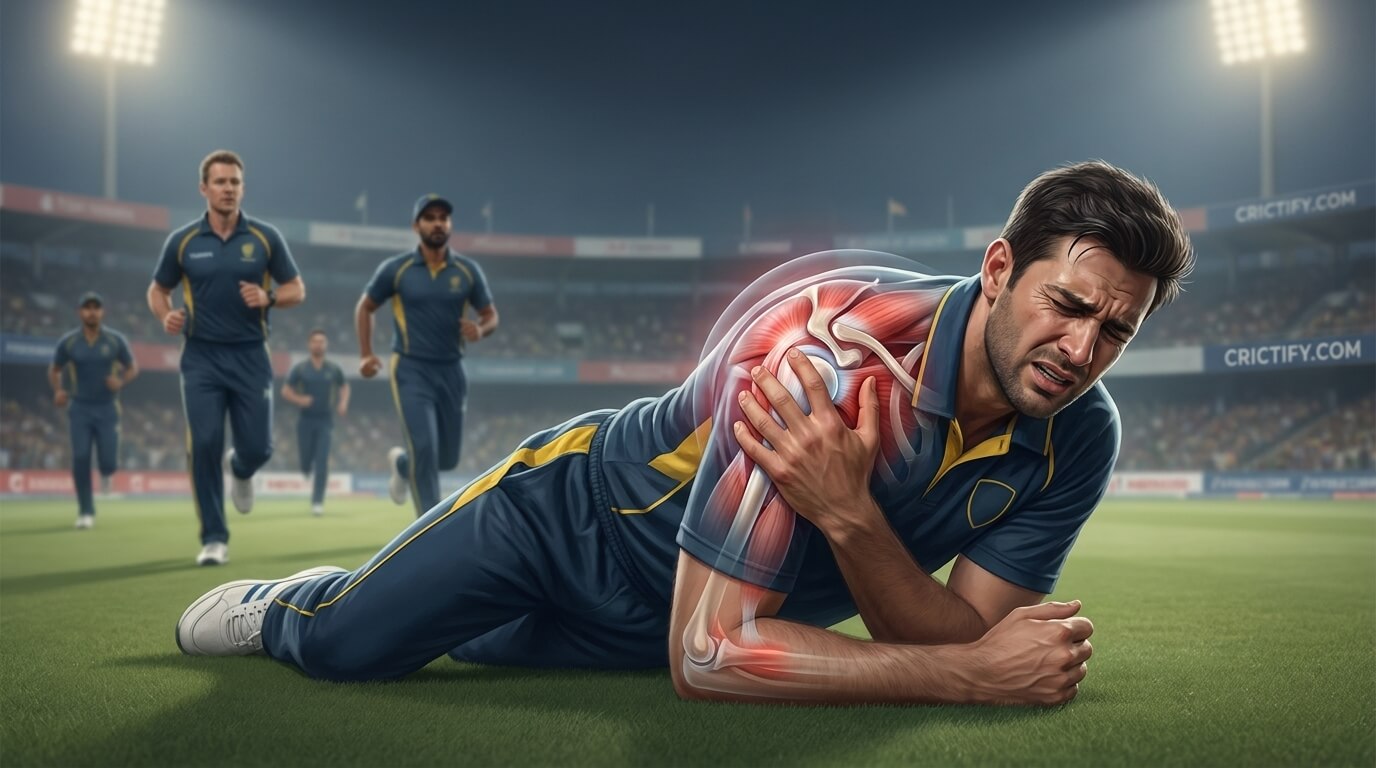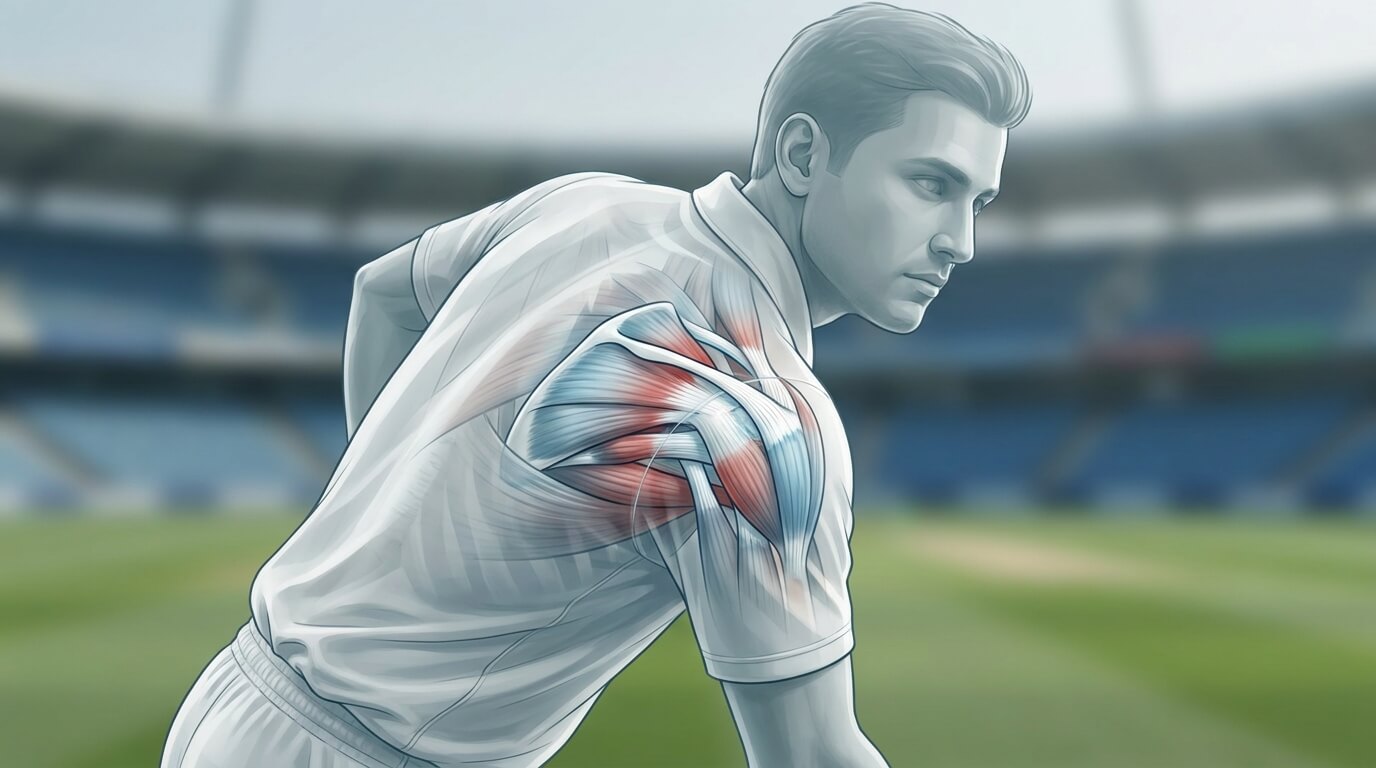
A wrist injury in cricket can affect far more than a player’s ability to grip a bat. The wrist helps control the bat face, transfer force during shots, position the hand during bowling, absorb impact while catching, and tolerate the sudden loads involved in throwing, diving, or falling.
Wrist pain may result from a mild overload problem, tendon irritation, ligament injury, fracture, or a condition involving the triangular fibrocartilage complex. Because several different structures can produce similar symptoms, persistent or significant pain should not automatically be assumed to be a simple sprain.
This guide explains the common causes, symptoms, medical assessment, treatment, rehabilitation exercises, workload considerations, and progressive return-to-play principles for cricketers of different ages and playing roles.
Quick Summary
- Wrist injuries in cricket may be caused by batting impact, repetitive grip, bowling, throwing, catching, diving, or falling onto the hand.
- Batters, wicketkeepers, fielders, and spin bowlers may experience different wrist demands depending on their technique and workload.
- Common problems include sprains, fractures, scaphoid injuries, TFCC injuries, tendon irritation, and overuse pain.
- Pain, swelling, bruising, stiffness, reduced grip, clicking, weakness, numbness, and loss of movement are important symptoms.
- Thumb-side wrist pain after a fall deserves medical attention because scaphoid injuries can initially appear deceptively mild.
- Diagnosis may involve a medical history, physical examination, X-ray, MRI, CT scan, or ultrasound, depending on the suspected injury.
- Treatment may include activity modification, protection, temporary immobilization, physiotherapy, progressive strengthening, and occasionally surgery.
- Wrist exercises should be matched to the diagnosis and rehabilitation stage. Aggressive strengthening is not appropriate for every painful wrist.
- Return to batting, bowling, throwing, wicketkeeping, and fielding should be gradual and based on function rather than a fixed calendar date.
- Preventing recurrence requires completed rehabilitation, sensible workload progression, sound technique, suitable equipment, sleep, nutrition, and early reporting of symptoms.
What Is a Wrist Injury?
A wrist injury is damage or irritation involving one or more structures around the wrist, including bones, joints, ligaments, tendons, cartilage, nerves, or surrounding soft tissues.
The injury may be:
- Acute, meaning it occurs suddenly after an event such as a fall, ball impact, awkward catch, or mishit.
- Overuse-related, meaning symptoms develop gradually after repeated loading without enough recovery.
- A combination of both, such as a wrist that becomes irritated through repeated batting and then worsens after one forceful shot.
In cricket, the same symptom can arise from very different causes. Pain on the little-finger side may involve the TFCC, tendon structures, or an ulna-related problem. Pain on the thumb side may involve tendons, joints, or the scaphoid. Pain after a fall may indicate a fracture even when swelling is limited.
For that reason, pain location can provide a clue but cannot confirm the diagnosis.
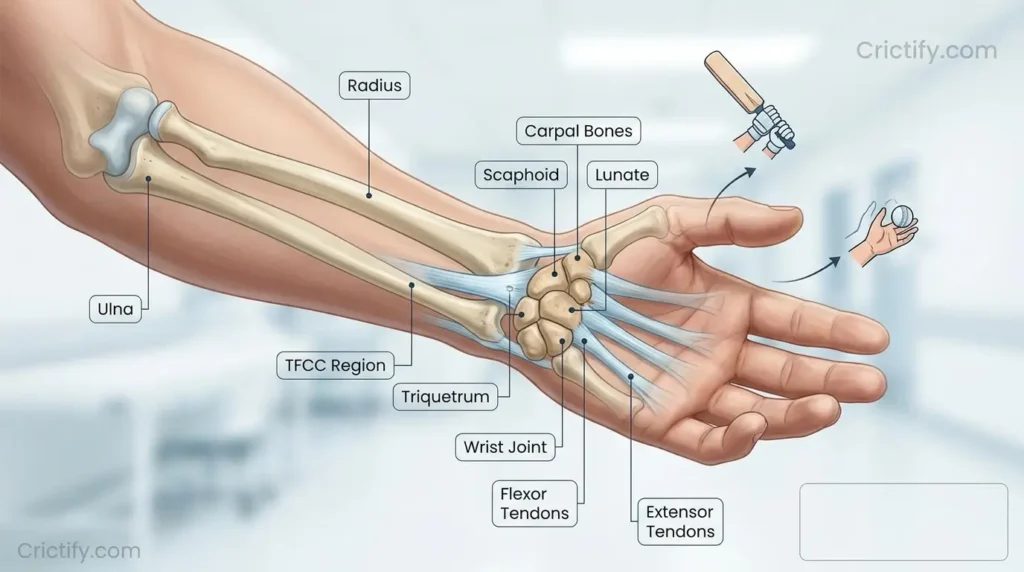
Understanding the Wrist Anatomy
The wrist is a compact meeting point between the forearm and hand. It must remain mobile enough to position the hand but stable enough to transmit force.
| Structure | Simple explanation | Cricket relevance |
|---|---|---|
| Radius | The larger forearm bone on the thumb side | Receives force during falls and helps form the main wrist joint |
| Ulna | The forearm bone on the little-finger side | Important in wrist rotation and load transfer |
| Carpal bones | Eight small bones arranged between the forearm and hand | Provide controlled movement and stability |
| Scaphoid | A small carpal bone near the base of the thumb | Can be injured after a fall onto an outstretched hand |
| Lunate | A central carpal bone | Contributes to wrist movement and load distribution |
| Triquetrum | A carpal bone toward the little-finger side | Works with other carpal bones during wrist motion |
| Ligaments | Strong bands connecting bones | Help prevent excessive movement and instability |
| Tendons | Strong cords connecting muscles to bones | Move the wrist, fingers, and thumb |
| Flexor tendons | Tendons on the palm side | Help flex the wrist and fingers and contribute to grip |
| Extensor tendons | Tendons on the back of the wrist and hand | Help extend the wrist and fingers |
| TFCC | A complex of cartilage, ligaments, and connective tissue on the little-finger side | Helps stabilize the wrist during rotation and loading |
The wrist also includes joints that allow flexion, extension, side-to-side movement, and rotation of the forearm. Cricket demands all of these actions.
A batter may need a stable wrist to control the bat face while allowing small adjustments through a drive, cut, pull, or late defensive shot. A bowler may require forearm rotation and carefully timed wrist and finger movement. A fielder needs the wrist to absorb force during a catch, control the ball during a throw, and tolerate ground contact during a dive.
Why Is the Wrist Important in Cricket?
The wrist is not an isolated joint. It is part of a chain that includes the fingers, hand, forearm, elbow, shoulder, trunk, and legs.
A change in one part of that chain can alter the load experienced by another. For example, a batter who grips the handle too tightly may reduce natural movement and transmit more shock into the wrist. A fielder who catches with poor hand position may allow force to collapse the wrist backward. A tired bowler may lose control of the forearm and wrist while trying to maintain pace or spin.
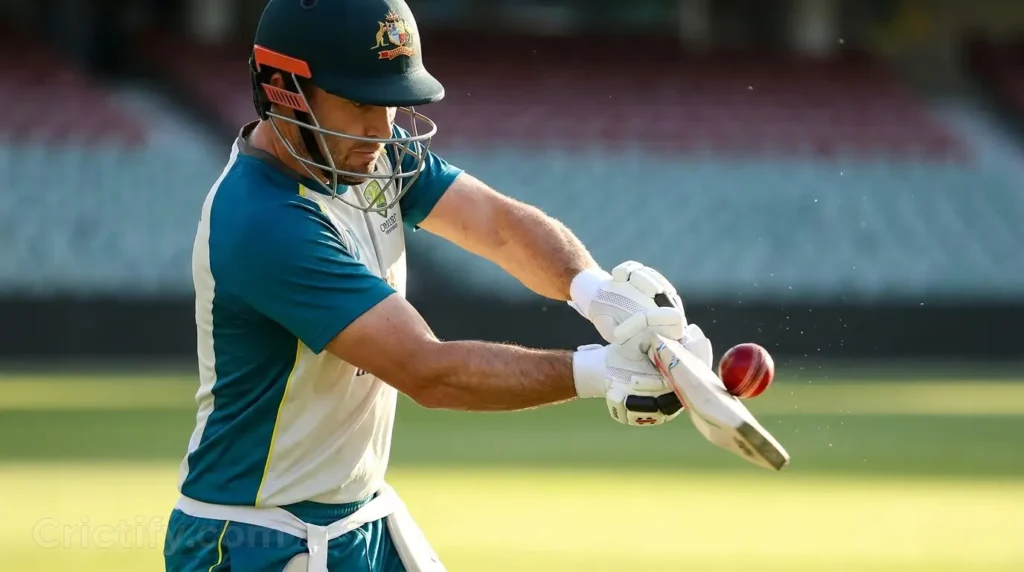
Batting
Batting places the wrist under both repeated and sudden loads.
A batter may repeatedly load the wrist when:
- Holding the bat for long periods.
- Controlling the bat face through drives and defensive shots.
- Rotating the forearm during cuts and pulls.
- Managing late movement from the ball.
- Absorbing vibration from mishits.
- Responding to fast deliveries.
- Practicing hundreds of repetitions in the nets.
- Changing grip pressure during different shots.
The top and bottom hands do not always experience the same demands. A batter may use the bottom hand to help control the bat through certain shots, while the top hand may help guide the bat path and stabilize impact. Excessive grip force, poor timing, fatigue, or an unsuitable bat setup may increase discomfort, although no single grip or bat specification prevents injury in every player.
A ball striking the bat near the edge, splice, or toe can create a sudden vibration and twisting force. A mishit may be more stressful than a cleanly timed shot because the bat does not transfer force smoothly.
Bowling
Bowling places different stresses on the wrist depending on the delivery, player, technique, and workload.
Fast bowlers generally rely on a coordinated sequence involving the run-up, lower body, trunk, shoulder, elbow, forearm, wrist, and fingers. The wrist helps position the hand and ball, but it should not be viewed as working independently from the rest of the bowling action.
Spin bowlers may place more visible emphasis on wrist position, forearm rotation, finger action, and release. Leg-spin, off-spin, wrist-spin variations, and changes of pace can all create different patterns of loading. Repeatedly forcing a particular wrist position or increasing variation volume too quickly may irritate tissues.
Potential contributors to wrist pain while bowling include:
- A sudden increase in bowling volume.
- Repeated high-intensity spells with inadequate recovery.
- Technical changes that alter forearm or wrist loading.
- Trying to generate spin mainly from the wrist without coordinated body movement.
- Bowling while fatigued.
- Returning to full delivery intensity too quickly after injury.
- Repeating a painful delivery to test the wrist.
Wrist pain during bowling is not automatically a sign of a serious injury, but recurring pain should be assessed rather than repeatedly ignored.
Wicket keeping
Wicket keepers experience repeated hand and wrist exposure throughout an innings.
Important demands include:
- Catching balls at varying speeds.
- Receiving balls that deviate unexpectedly.
- Absorbing repeated glove impact.
- Moving from a crouched position.
- Diving to either side.
- Landing on the hand or forearm.
- Supporting body weight during ground contact.
- Reaching into awkward wrist positions.
- Repeating these actions for long periods.
Gloves reduce some impact but do not eliminate wrist loading. A keeper may also be exposed to sudden extension when reaching for a low ball or landing awkwardly during a dive.
Fielding, Catching, and Throwing
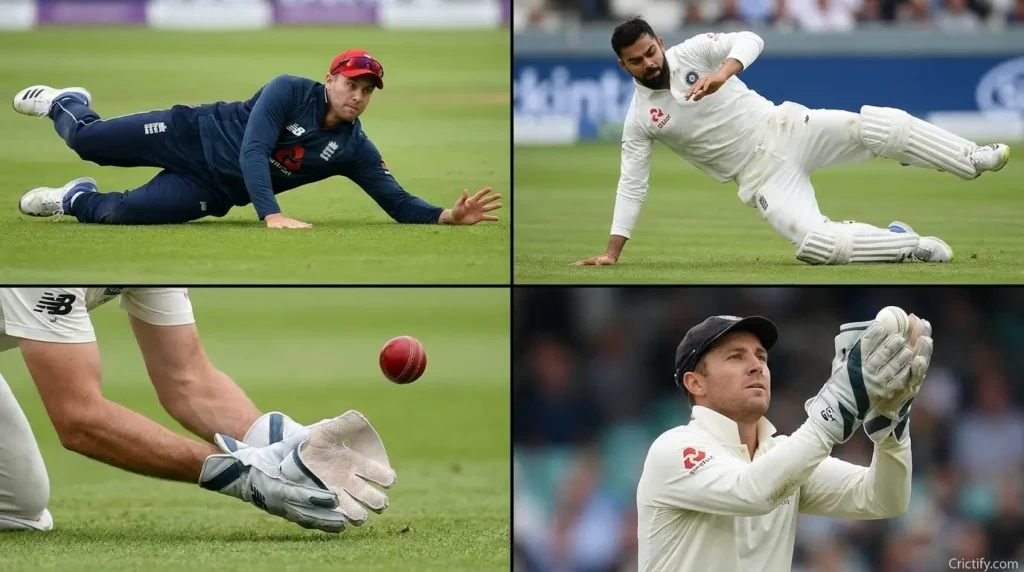
Fielders may injure the wrist through a single high-force event or through repeated lower-level loads.
Examples include:
- A hard catch that forces the wrist backward.
- A one-handed catch made at full reach.
- A ball striking the hand or wrist.
- A dive followed by hand-first ground contact.
- A rapid pick-up followed by an urgent throw.
- Repeated boundary throws.
- A long throw made when fatigued.
- A sudden twist while changing direction.
The wrist must rapidly shift from absorbing force to producing force. A fielder may catch the ball, rotate the forearm, collect it securely, and throw within seconds. That combination can expose the wrist to compression, rotation, extension, and gripping demands in a short period.
Repetitive Training
A player may tolerate a particular skill during a match but develop symptoms during training because of volume. Nets, throwing drills, catching circuits, bowling spells, and wicketkeeping practice can create large cumulative loads.
Training is not automatically safer than competition. Repetitions are often higher, technical focus may encourage repeated practice of one movement, and players may continue despite early symptoms because the session is structured around volume.
How Common Are Wrist Injuries in Cricket?
Wrist injuries are part of the broader group of hand and upper-limb problems seen in cricket. The overall pattern varies by playing level, age, role, playing surface, equipment, training schedule, and injury definition.
Cricket combines repetitive skill execution with occasional high-force events. That makes it possible for a player to develop an overuse problem through repeated batting or bowling and also sustain an acute injury during a fall, catch, or ball impact.
The exact frequency of wrist injuries is difficult to summarize with one universal figure because studies differ in how they record injuries. Some count only time-loss injuries, while others include pain managed during training. A club player who continues playing with wrist pain may not appear in the same statistics as a professional who misses a match.
The practical lesson is that wrist symptoms should be considered in context:
- Sudden pain after trauma deserves a different approach from gradual soreness.
- Persistent symptoms deserve attention even when the player can still bat.
- A junior athlete may require a lower threshold for assessment.
- A professional may need detailed role-specific testing before returning to competition.
Which Cricket Players Are Most at Risk?
Batters
Batters are exposed to gripping, repeated impact, vibration, forearm rotation, and sudden force from mishits. Players who face long net sessions or make frequent technical changes may notice symptoms first during practice.
Fast Bowlers
Fast bowlers may develop wrist symptoms when workload rises quickly, mechanics change, or fatigue affects control of the arm and hand. The wrist is one link in a high-speed kinetic chain.
Spin Bowlers
Spin bowlers may place repeated demands on wrist positioning, forearm rotation, and finger release. High volumes of variation practice can be particularly demanding if introduced abruptly.
Wicket keepers
Keepers face repeated catching, glove impact, diving, ground contact, and awkward wrist positions. Their exposure may be high even when no single action appears unusually forceful.
Fielders
Fielders experience unpredictable loads from catching, throwing, diving, and falling. Boundary fielders may be exposed to long throws, while close fielders may face rapid reaction and ground-contact demands.
Junior Cricketers
Young players are still developing coordination, strength, technique, and skeletal maturity. Persistent wrist pain should not be dismissed as normal growing pain or treated by simply reducing discomfort long enough to continue playing.
Professional Cricketers
Professionals may be exposed to dense schedules, travel, high training volume, repeated matches, and pressure to return quickly. Their rehabilitation often needs close coordination between medical staff, coaches, strength and conditioning staff, and the player.
Common Wrist Injuries in Cricketers
Wrist Sprain
A wrist sprain involves stretching or tearing of one or more ligaments. It may occur after a fall onto the hand, awkward landing, sudden twisting, forceful catch, or direct impact.
Symptoms can include:
- Pain around the wrist.
- Swelling or bruising.
- Pain with gripping.
- Reduced movement.
- Tenderness.
- A feeling of weakness or instability.
Mild sprains may improve with protection and progressive rehabilitation. More significant ligament injuries may require imaging, immobilization, specialist review, or surgery. The phrase “sprain” should not be used to minimize symptoms before the injury has been assessed.
Wrist Fracture
A fracture is a break or crack in a bone. In cricket, possible mechanisms include:
- Falling onto an outstretched hand.
- Direct impact from the ball.
- A bat striking the wrist or hand.
- A forceful collision.
- Landing awkwardly during a dive.
Some fractures are obvious, but others may cause only modest swelling or pain. A player who can move the wrist does not automatically exclude a fracture.
Scaphoid Injury
The scaphoid is a small bone on the thumb side of the wrist. It may be injured after a fall onto an outstretched hand or another force that bends the wrist backward.
Possible symptoms include:
- Pain near the base of the thumb.
- Tenderness in the hollow between the thumb tendons.
- Pain during gripping or pinching.
- Pain with wrist movement.
- Swelling that may be limited or absent.
- Reduced confidence using the hand.
Scaphoid injuries deserve particular attention because they may be difficult to identify immediately. Some fractures do not make the wrist look deformed and may initially produce only minor symptoms. Delayed assessment can complicate management if the bone does not heal normally.
Pain on the thumb side does not prove a scaphoid fracture, and an absence of dramatic swelling does not rule one out. A healthcare professional may use examination, X-rays, immobilization, and further imaging when appropriate.
TFCC Injury
TFCC stands for triangular fibrocartilage complex. It is a group of cartilage and connective-tissue structures on the little-finger side of the wrist that contributes to stability, especially during forearm rotation and loading.
A TFCC problem may develop after:
- A fall.
- A twisting injury.
- Repeated rotation.
- Forceful gripping.
- Loading the wrist while it is extended.
- Repetitive throwing or batting demands.
Symptoms can include:
- Pain on the little-finger side.
- Clicking or catching.
- Pain during forearm rotation.
- Pain while gripping.
- Reduced tolerance for push-up-type loading.
- A sense of weakness or instability.
TFCC symptoms can overlap with other wrist conditions. Assessment may include specific stability and movement tests, and imaging may be considered depending on the clinical picture.
Tendon-Related Wrist Problems
Tendons transmit muscle force to the wrist, fingers, and thumb. Repeated batting, gripping, throwing, or bowling can irritate a tendon or the surrounding tissue.
Tendon-related symptoms often include:
- Pain with a particular movement.
- Tenderness along the tendon.
- Pain that increases with repeated use.
- Stiffness at the beginning of activity.
- Reduced tolerance for gripping or wrist motion.
A tendon problem may improve with a carefully modified load, but complete rest is not always the long-term answer. The correct rehabilitation plan depends on the specific tendon and stage of irritation.
Overuse Wrist Pain
Overuse pain develops when repeated loading exceeds the wrist’s current capacity. This may happen after:
- A sudden increase in batting.
- A new bowling variation.
- Extra throwing practice.
- A tournament with little recovery.
- A change in bat weight or grip.
- A return from injury.
- Repeatedly training through early warning symptoms.
Overuse symptoms may start as discomfort near the end of a session and later appear earlier, last longer, or affect everyday gripping. That progression is a reason to intervene early.
Other Wrist Conditions
Several joints, bones, tendons, ligaments, and nerves can produce similar symptoms. A player may have a joint irritation, cartilage problem, bone stress response, nerve-related symptom, or an issue referred from the forearm or elbow.
The purpose of assessment is to identify the structure most likely involved and determine what level of loading is safe.
Acute vs Overuse Wrist Injuries
| Feature | Acute injury | Overuse injury |
|---|---|---|
| Typical onset | Sudden | Gradual |
| Common mechanism | Fall, impact, catch, dive, sudden twist | Repeated batting, bowling, throwing, or catching |
| Early symptoms | Immediate pain, swelling, bruising, loss of function | Soreness during or after training, stiffness, declining tolerance |
| Cricket example | Fielder lands on the hand while diving | Batter develops pain after several high-volume net sessions |
| Main concern | Fracture, significant sprain, dislocation, or acute tendon injury | Tendon irritation, load intolerance, or developing tissue overload |
| Initial priority | Protect the wrist and assess severity | Modify the provoking load and identify the training error |
| Progression | Guided by examination, imaging, and healing | Guided by symptom response, capacity, and gradual loading |
An overuse injury can still become acute if an already-irritated wrist is exposed to a sudden high load. Conversely, an acute injury may develop persistent symptoms if rehabilitation is incomplete.
Common Causes of Wrist Injuries in Cricket
Common causes include:
- Falling onto the hand during a dive.
- Direct impact from the cricket ball.
- Bat impact or severe vibration after a mishit.
- Repeated gripping during long batting sessions.
- High-volume net practice.
- Repetitive wrist and finger action during spin bowling.
- Repeated bowling while fatigued.
- Catching hard balls with poor hand position.
- Throwing repeatedly from the boundary.
- Sudden forearm rotation.
- Hyperextension during a fall or catch.
- Poor technique or poorly timed movement.
- Sudden increases in training or match volume.
- Returning before strength and movement have recovered.
- Previous injury that has not been fully rehabilitated.
- Inadequate recovery between sessions.
Risk Factors for Wrist Injuries in Cricketers
| Risk factor | Why it may increase risk | Cricket-specific consideration |
|---|---|---|
| Previous wrist injury | Strength, movement, or confidence may remain reduced | Symptoms may return during nets before a match |
| Sudden workload increase | Tissue capacity may lag behind exposure | A player may add extra nets, bowling, or throwing |
| High batting volume | Repeated grip and impact accumulate | Long sessions can produce symptoms even with sound technique |
| High bowling volume | Repeated wrist and forearm loading can exceed tolerance | Spin variations may add a different demand |
| High throwing volume | Rotation and gripping are repeated at speed | Boundary throws may be introduced too quickly |
| Fatigue | Coordination and movement quality may decline | Late-session catches and throws may become less controlled |
| Poor technique | Force may be concentrated in the wrist | Technical review should consider the whole movement chain |
| Weak grip or forearm capacity | The wrist may struggle to control force | Strength should be developed progressively |
| Inadequate recovery | Tissue adaptation requires time | Tournament schedules may reduce recovery opportunities |
| Poor rehabilitation | The player may regain comfort before capacity | Match intensity can expose the remaining deficit |
| Age and skeletal maturity | Young players have developing bones and tissues | Persistent pain needs appropriate assessment |
| Equipment changes | A different setup may alter grip and impact | Bat weight and handle feel should be adapted carefully |
Symptoms of Wrist Injury in Cricket
| Symptom | What it may feel like | Why it matters |
|---|---|---|
| Pain | Ache, sharp pain, or pain with a particular movement | Location and triggers help guide assessment |
| Tenderness | Pain when pressing a specific area | May indicate a local bone, tendon, or ligament problem |
| Swelling | Puffiness or fullness around the wrist | Can follow trauma or tissue irritation |
| Bruising | Skin discoloration after impact or a fall | May indicate bleeding into soft tissues |
| Stiffness | Difficulty bending, straightening, or rotating | May limit batting, bowling, or throwing |
| Weak grip | Reduced ability to hold the bat or ball | May reflect pain, weakness, or structural injury |
| Clicking or popping | A sound or sensation during movement | May require assessment if painful or associated with instability |
| Instability | A feeling that the wrist shifts or gives way | Can occur with ligament or TFCC problems |
| Numbness or tingling | Pins-and-needles or altered sensation | May involve nerve irritation and needs attention |
| Reduced movement | The player cannot use the wrist normally | Significant loss of function should not be ignored |
Pain while gripping the bat, rotating the forearm, catching, throwing, or bowling is especially relevant because it shows that the wrist is not tolerating a cricket-specific demand.
Early Warning Signs Cricketers Should Not Ignore
Early symptoms deserve attention when they:
- Appear after every net session.
- Worsen as the session continues.
- Remain into the following day.
- Return whenever the player resumes cricket.
- Increase during gripping.
- Occur during spin bowling or throwing.
- Are accompanied by repeated swelling.
- Produce clicking with pain.
- Reduce grip strength.
- Limit wrist movement.
- Follow a fall or direct impact.
- Continue despite several days of sensible modification.
- Gradually become more frequent or intense.
Recurring symptoms may indicate that the current workload exceeds the wrist’s capacity or that the underlying diagnosis has not been identified.
What Should a Cricketer Do Immediately After a Wrist Injury?
After a sudden wrist injury:
- Stop the activity if continuing causes pain or loss of function.
- Protect the wrist from additional impact, gripping, and forceful movement.
- Avoid repeatedly testing the painful motion.
- Remove rings or tight items if swelling is developing.
- Observe for deformity, increasing swelling, bruising, numbness, or color change.
- Arrange medical assessment when the injury is significant or function is reduced.
- Do not return immediately to batting, bowling, throwing, or catching simply because the pain temporarily settles.
There is no need to force the wrist through painful movement to “keep it loose.” A clinician can advise whether protection, a brace, or immobilization is appropriate.
How Is a Wrist Injury Diagnosed?
Diagnosis begins with a detailed history. A clinician may ask:
- What happened?
- Did the wrist bend backward, twist, or receive a direct blow?
- Did symptoms start during batting, bowling, catching, or throwing?
- Was there a fall?
- Did swelling appear immediately or later?
- Can the player grip, rotate the forearm, and move the fingers?
- Has the player had a previous wrist injury?
- How much cricket has been played recently?
- Which actions reproduce the pain?
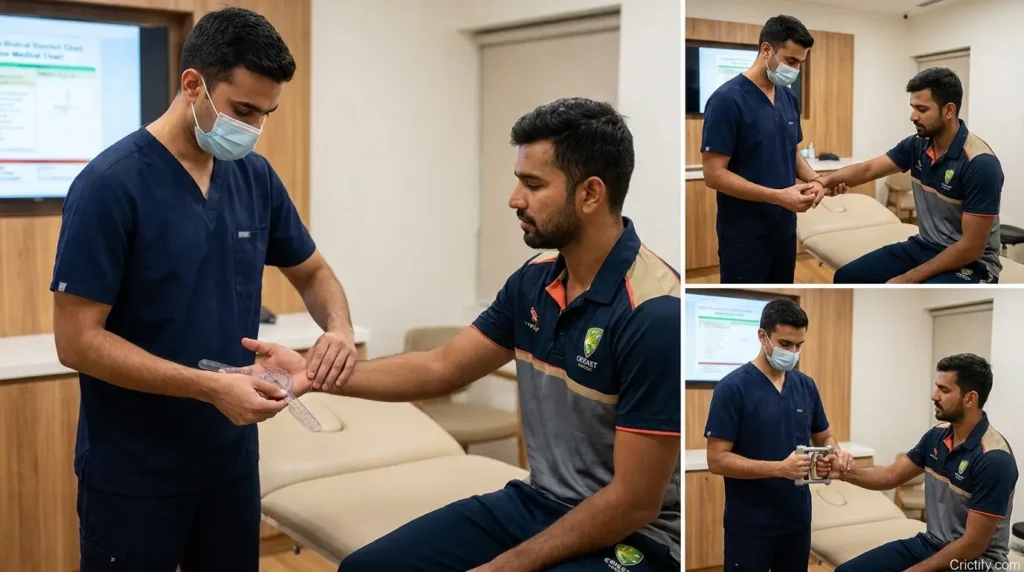
The physical examination may include:
- Inspection for swelling, bruising, or deformity.
- Palpation of bones, joints, tendons, and ligament regions.
- Wrist flexion and extension.
- Forearm pronation and supination.
- Finger and thumb movement.
- Grip strength.
- Pain response to resisted movement.
- Stability testing where appropriate.
- Sensation and circulation.
- Functional assessment related to the player’s role.
The clinician may compare both wrists, but the uninjured wrist is not a perfect standard because natural differences exist.
A player may be able to perform a basic movement yet remain unable to tolerate a high-speed catch, full-power throw, or repeated bat impact. That is why cricket-specific functional testing is important during later rehabilitation.
Medical Imaging
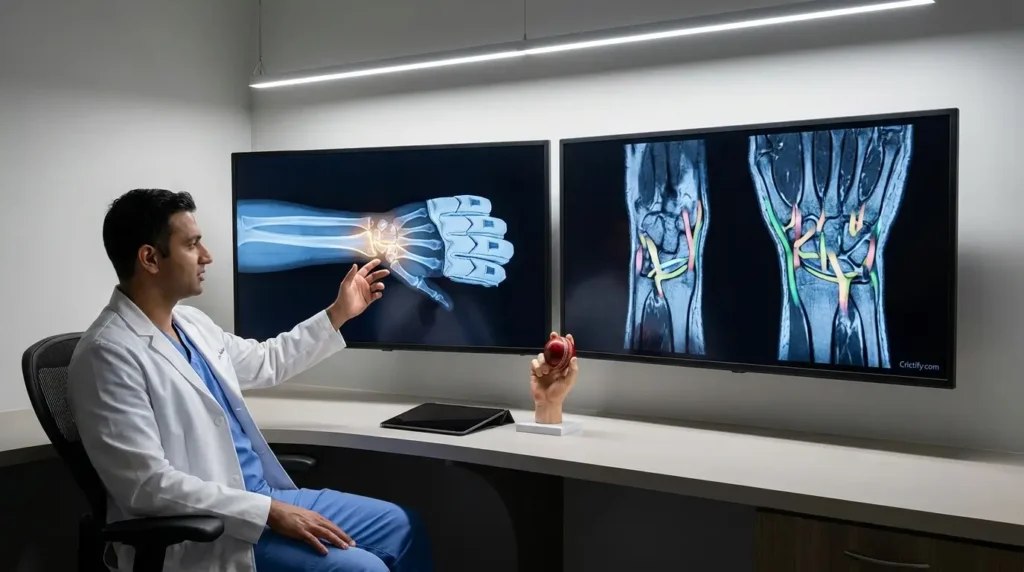
No single imaging test is best for every wrist injury. The choice depends on the suspected structure, injury mechanism, examination findings, and how symptoms progress.
X-ray
X-rays can help identify:
- Many fractures.
- Bone alignment.
- Dislocations.
- Some joint changes.
- Certain signs of healing or chronic injury.
An early X-ray does not always identify every fracture. If clinical suspicion remains, a clinician may recommend protection and follow-up assessment or additional imaging.
MRI
MRI can provide information about:
- Ligaments.
- Tendons.
- Cartilage.
- Bone marrow changes.
- Some fractures that are difficult to see on initial X-rays.
- Soft-tissue structures such as the TFCC.
MRI is not automatically required for every wrist injury. It may be considered when symptoms persist, the examination suggests a soft-tissue injury, or the initial assessment does not adequately explain the player’s limitations.
CT Scan
CT provides detailed views of bone. It may be useful for selected fractures, complex injuries, bone alignment, or surgical planning.
Ultrasound
Ultrasound may help assess certain superficial tendons and soft tissues. It can also allow dynamic examination while a structure moves, although it is not suitable for every wrist problem.
| Imaging test | What it can show | When it may be considered |
|---|---|---|
| X-ray | Many fractures, alignment, dislocation, some joint changes | After trauma or when a bone injury is suspected |
| MRI | Ligaments, tendons, cartilage, bone marrow, selected fractures | Persistent symptoms or suspected soft-tissue injury |
| CT | Detailed bone anatomy and complex fracture patterns | Selected fractures or preoperative planning |
| Ultrasound | Some superficial tendons and soft tissues | Tendon symptoms or dynamic assessment |
Treatment for Wrist Injuries in Cricketers
Treatment depends on the exact diagnosis, severity, symptoms, age, playing role, and functional demands.
Activity Modification
Activity modification means reducing or temporarily removing the movements that aggravate the wrist while maintaining safe general conditioning where possible.
For a batter, this may mean pausing full-power shots but continuing lower-body conditioning. For a bowler, it may mean reducing delivery intensity or avoiding a painful variation. For a fielder, it may mean limiting high-speed throws and diving until the wrist tolerates controlled loading.
Protection and Immobilization
A brace, splint, or cast may be appropriate for selected injuries. Protection can reduce movement while a fracture, significant sprain, or other structure heals.
Immobilization should not be used casually or indefinitely. Prolonged restriction can lead to stiffness, weakness, and reduced confidence. The timing of movement should be guided by the diagnosis.
Pain Management
Pain-management decisions should consider the player’s medical history, age, other medications, kidney and stomach health, and the nature of the injury. A healthcare professional should advise on medication rather than treating pain relief as permission to continue full cricket.
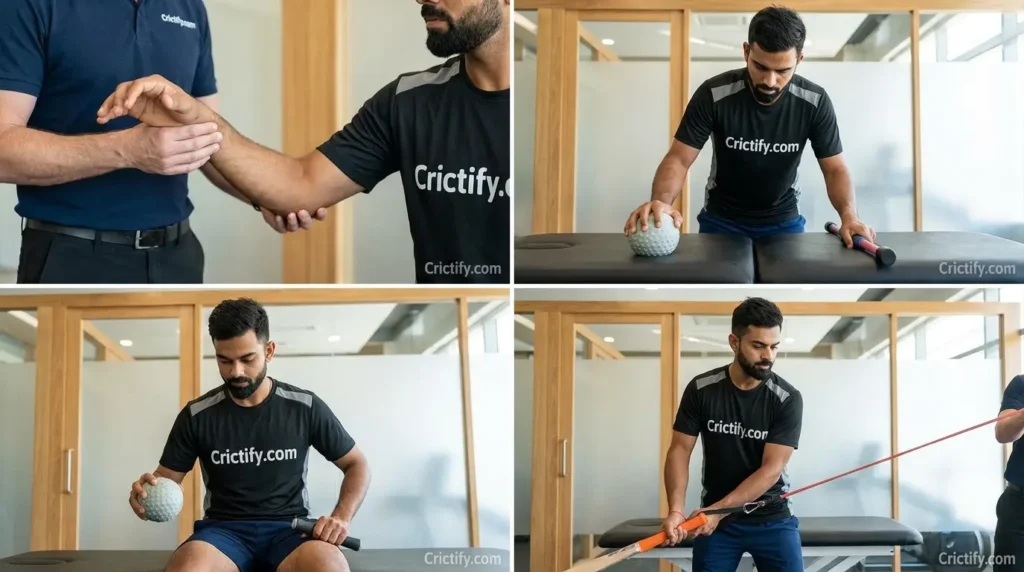
Physiotherapy
Physiotherapy may address:
- Wrist and forearm movement.
- Grip and finger strength.
- Wrist stability.
- Tendon capacity.
- Shoulder and elbow contribution.
- Throwing mechanics.
- Batting mechanics.
- Bowling mechanics.
- Functional loading.
- Confidence and return-to-play progression.
Progressive Loading
A wrist usually needs more than symptom reduction. It must gradually regain the capacity to tolerate gripping, rotation, impact, speed, repetition, and fatigue.
Surgery
Surgery may be considered for selected fractures, significant ligament injuries, instability, certain TFCC problems, or injuries that do not respond to appropriate nonsurgical management. The decision depends on the diagnosis and the player’s individual circumstances.
| Treatment | Main goal | When it may help | Important consideration |
|---|---|---|---|
| Activity modification | Reduce aggravating load | Pain linked to a specific cricket action | Avoid replacing one painful activity with another |
| Protection | Prevent further injury | Early phase after trauma or significant irritation | The appropriate level depends on diagnosis |
| Splint or brace | Limit harmful movement | Selected sprains, fractures, or painful conditions | Incorrect or prolonged use can cause stiffness |
| Physiotherapy | Restore movement and capacity | Most rehabilitation pathways | Must be individualized |
| Strength training | Improve grip and forearm control | After adequate healing and symptom control | Progress gradually |
| Cricket-specific drills | Rebuild skill tolerance | Later rehabilitation | Increase speed, volume, and unpredictability progressively |
| Surgery | Repair or stabilize selected injuries | Some fractures, instability, or persistent structural problems | Requires individualized specialist review |
Physiotherapy for Wrist Injuries in Cricket
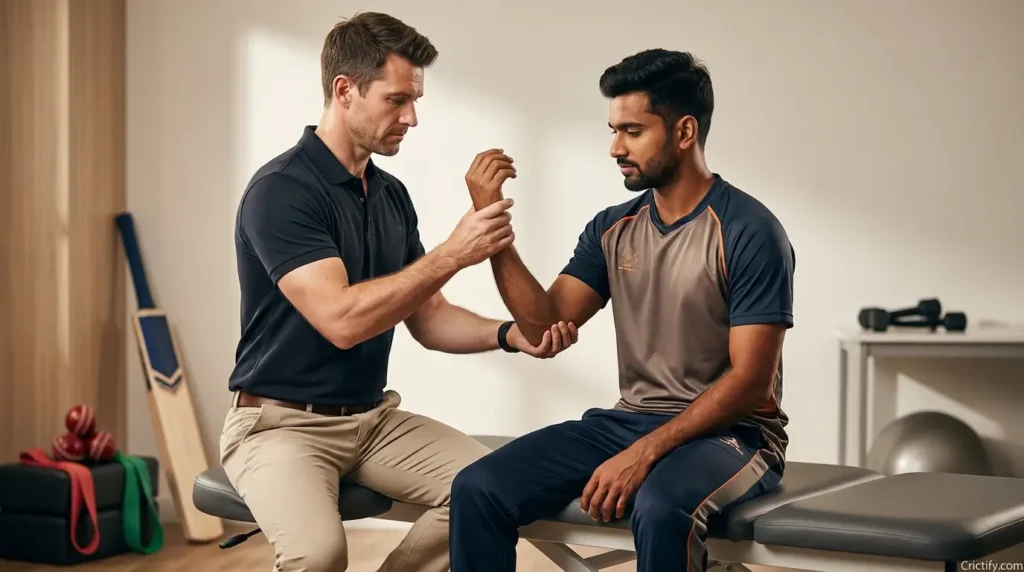
A sports physiotherapist may assess the wrist in the context of the entire upper limb.
Important questions include:
- Is wrist movement restricted?
- Is grip weakness caused by pain or true loss of strength?
- Can the player rotate the forearm comfortably?
- Does the shoulder or elbow contribute to altered mechanics?
- Can the athlete absorb force during catching?
- Can the player control the bat without excessive grip tension?
- Can a bowler repeat the delivery without symptoms?
- Can a fielder throw at increasing speeds and distances?
- Can a wicketkeeper catch and dive safely?
Rehabilitation should match the player’s role. A batter and wicketkeeper may both have wrist pain but require different final-stage testing. A spin bowler may need repeated rotation and release work, whereas a fast bowler may need to rebuild control within a high-speed delivery sequence.
Exercises for Wrist Rehabilitation
Exercises are not universally safe for every wrist injury. A player with an undiagnosed fracture, significant swelling, acute trauma, or postoperative restrictions should not begin aggressive strengthening without appropriate guidance.
Isometric Wrist Exercise
An isometric exercise involves producing muscle tension without obvious joint movement.
Purpose: Maintain or develop muscle activation while limiting movement.
Basic technique: Place the forearm in a comfortable position and press gently against the opposite hand or a stable object without forcing the wrist into pain.
Cricket relevance: It may help prepare the wrist for later grip and bat-control work.
Common mistake: Pressing too hard or holding the wrist in a painful position.
Stop if: Pain increases sharply, swelling worsens, or symptoms continue to escalate after the exercise.
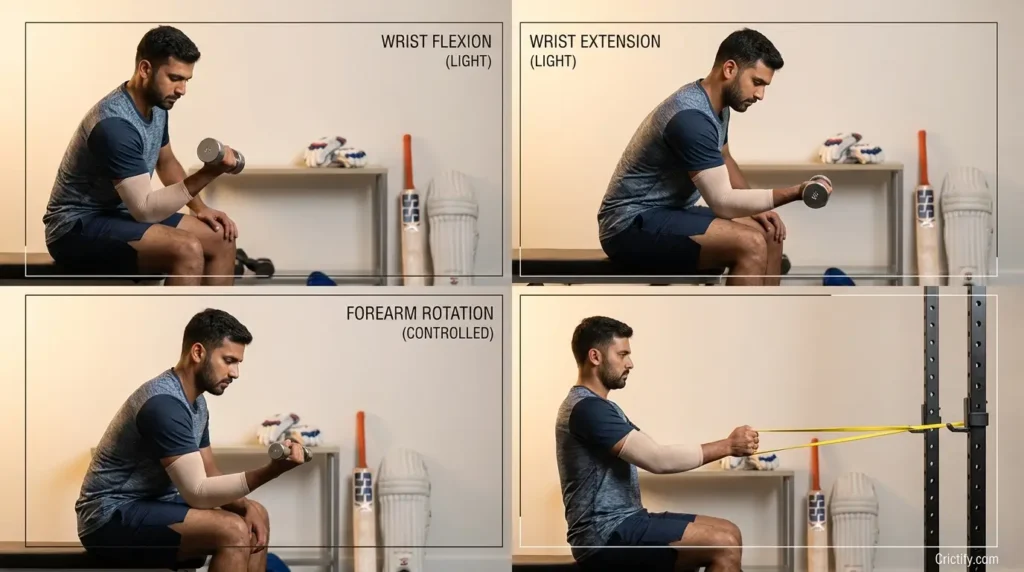
Wrist Flexion Strengthening
Purpose: Develop the muscles that help flex the wrist.
Basic technique: Support the forearm, hold a light resistance such as a small dumbbell, and slowly move the wrist through a comfortable range.
Cricket relevance: Supports grip control and bat handling.
Common mistake: Moving the entire forearm instead of isolating controlled wrist movement.
Wrist Extension Strengthening
Purpose: Develop the muscles on the back of the forearm.
Basic technique: Support the forearm with the palm facing downward and lift the hand slowly against light resistance.
Cricket relevance: Helps with wrist control during batting, catching, and throwing.
Common mistake: Using excessive weight or rushing the lowering phase.
Forearm Pronation and Supination
Pronation turns the palm downward; supination turns it upward.
Purpose: Restore controlled forearm rotation.
Basic technique: Hold a light object such as a small hammer or resistance tool and rotate slowly within a comfortable range.
Cricket relevance: Forearm rotation contributes to batting adjustments, throwing, and bowling.
Common mistake: Forcing the end range or compensating through the shoulder.
Grip Strengthening
Purpose: Rebuild the ability to hold a bat, ball, or glove.
Basic technique: Use a soft ball or approved grip device and apply controlled pressure without provoking symptoms.
Cricket relevance: Supports bat control, ball security, catching, and throwing.
Common mistake: Performing high-volume squeezing while the wrist is still painful.
Finger and Thumb Strengthening
Purpose: Improve hand control and force distribution.
Basic technique: Use gentle elastic resistance or controlled finger movements as advised.
Cricket relevance: The fingers help guide the bat, release the ball, and secure catches.
Common mistake: Focusing only on the wrist while ignoring finger control.
Progressive Functional Loading
Later-stage loading may involve:
- Holding the bat for increasing periods.
- Gentle bat movements.
- Controlled ball handling.
- Light catching.
- Short-distance throwing.
- Resistance exercises in cricket-specific positions.
| Exercise | Main purpose | Cricket relevance | Important note |
|---|---|---|---|
| Isometric wrist work | Muscle activation with limited movement | Early preparation for grip and control | Use only when appropriate for the injury |
| Wrist flexion | Flexor strength | Bat grip and ball control | Use light resistance initially |
| Wrist extension | Extensor strength | Catching, throwing, and bat stability | Avoid painful loading |
| Pronation and supination | Forearm rotation | Bowling, throwing, and batting adjustments | Keep movement controlled |
| Grip exercise | Hand and forearm capacity | Batting, catching, and throwing | Do not chase fatigue during early recovery |
| Finger and thumb work | Fine control | Ball release and secure catching | Progress according to symptoms |
| Functional loading | Transfer strength to cricket | Role-specific return | Introduce speed and repetition gradually |
Wrist Rehabilitation for Cricketers
Rehabilitation is best viewed as a progression of capacity rather than a race to eliminate pain.
Stage 1 — Protect the Wrist and Control Symptoms
Main objective: Prevent further irritation and identify the injury.
Training focus: General fitness that does not load the wrist excessively, as permitted.
What may be avoided: Batting impact, forceful gripping, throwing, diving, and painful wrist movement.
Progression consideration: Swelling, pain, diagnosis, and medical advice guide the next step.
Stage 2 — Restore Comfortable Movement
Main objective: Recover safe wrist and forearm motion.
Training focus: Gentle range of motion and movement of the fingers, thumb, elbow, and shoulder.
What may be avoided: Forced stretching and painful end-range loading.
Functional goal: Move the wrist sufficiently for basic daily tasks without increasing symptoms.
Stage 3 — Restore Grip and Forearm Strength
Main objective: Rebuild the muscles that control the wrist and hand.
Training focus: Isometrics, light resistance, grip, finger, and forearm rotation exercises.
What may be avoided: Heavy fatigue, high repetition, and sudden gripping.
Functional goal: Hold a bat, ball, or glove in a controlled manner.
Stage 4 — Restore Wrist Stability
Main objective: Improve control under changing loads.
Training focus: Controlled resistance, weight-bearing progressions where appropriate, and coordinated hand-arm control.
What may be avoided: Unpredictable impact and fast reaction drills until control improves.
Functional goal: Maintain wrist position during controlled cricket-related tasks.
Stage 5 — Progressive Loading
Main objective: Prepare the wrist for more force and repetition.
Training focus: Increased resistance, longer exposure, light catching, bat handling, and controlled throwing.
What may be avoided: Maximum force, full-speed dives, and high-volume sessions.
Functional goal: Tolerate progressive training without a delayed symptom flare.
Stage 6 — Cricket-Specific Skills
Main objective: Rebuild the exact movements required by the player’s role.
Training focus: Shadow batting, controlled bowling, short throws, catching, glove work, and position-specific drills.
What may be avoided: Full unpredictability and maximal intensity at the beginning.
Functional goal: Complete skill sessions with appropriate control and no concerning response.
Stage 7 — Return to Training
Main objective: Tolerate normal practice demands.
Training focus: Gradual increases in speed, volume, contact, and decision-making.
What may be avoided: Sudden full-session exposure after a period of restriction.
Functional goal: Participate in training and recover appropriately afterward.
Stage 8 — Return to Competition
Main objective: Perform safely under match conditions.
Training focus: Match simulation, pressure, unpredictability, fatigue, and role-specific exposure.
What may be avoided: Competition if the player cannot meet functional requirements.
Functional goal: Complete the relevant match tasks with acceptable symptoms, confidence, and medical clearance when needed.
Wrist Injury Recovery Timeline
Recovery varies considerably. A mild irritation may settle relatively quickly after a sensible reduction in load, while a fracture, significant ligament injury, scaphoid injury, TFCC problem, or surgical procedure may require a much longer and more structured process.
| Injury type or stage | General recovery consideration | What determines progression |
|---|---|---|
| Mild load-related irritation | Symptoms may improve after modifying the provoking activity | Response to reduced load and gradual reloading |
| Tendon irritation | Capacity must be rebuilt progressively | Pain behavior, strength, and tolerance for repetition |
| Mild sprain | Protection and movement may be needed initially | Stability, swelling, range of motion, and function |
| Significant sprain | May require specialist assessment or immobilization | Ligament stability and imaging findings |
| Scaphoid injury | Healing and protection may require careful follow-up | Fracture location, healing, imaging, and symptoms |
| TFCC injury | Rotation and loading may need gradual restoration | Stability, pain, examination, and response to rehabilitation |
| Fracture | Return depends on bone healing and medical review | Imaging, healing, movement, strength, and function |
| Post-surgical rehabilitation | Progression follows the procedure and surgeon’s plan | Surgical findings, healing, and therapy milestones |
| Return-to-sport phase | Cricket exposure increases in stages | Batting, bowling, throwing, catching, fatigue, and confidence |
Feeling better is not the same as being ready for full match intensity. The wrist must tolerate the speed, volume, impact, and unpredictability of the player’s role.
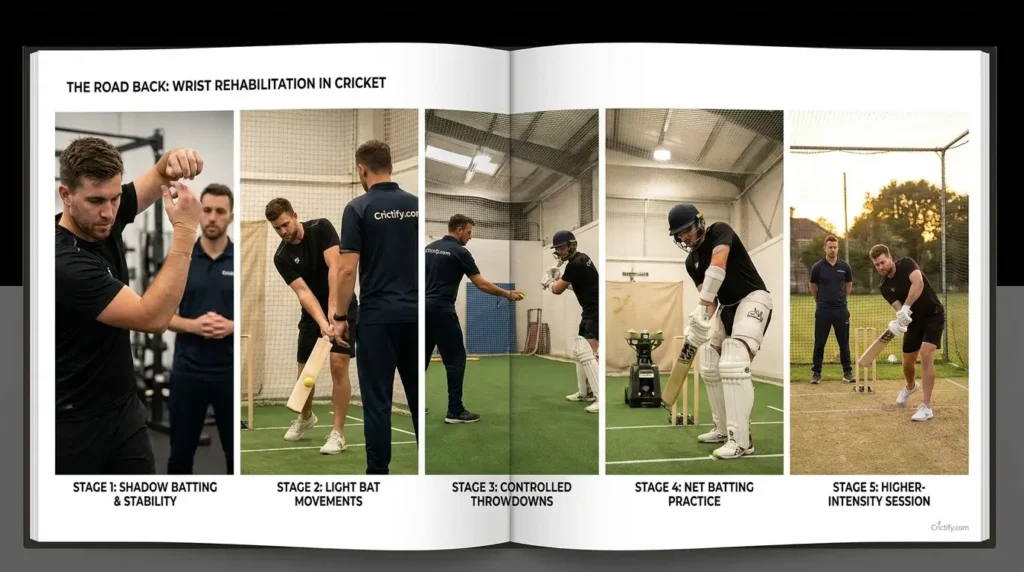
Returning to Batting After a Wrist Injury
Returning to batting should be progressive and specific to the player’s symptoms and injury.
1. Grip Testing
Begin by checking whether the player can hold the bat comfortably without excessive tension, pain, or weakness.
Consider:
- Light grip.
- Neutral wrist position.
- Short periods of holding.
- Releasing and regripping.
- Simulated stance.
2. Shadow Batting
Shadow batting allows the player to rehearse movement without ball impact.
Start with:
- Defensive movements.
- Controlled drives.
- Gentle bat-face positioning.
- Short sets with rest.
3. Light Bat Movements
The player may gradually increase bat speed while avoiding forceful contact. The aim is to assess control, not to prove toughness.
4. Controlled Throwdowns
Introduce gentle, predictable deliveries. Begin with a manageable shot range and monitor the wrist during and after exposure.
5. Gentle Net Sessions
Increase the number of balls gradually. The player should not move directly from a few pain-free throwdowns to a full net session.
6. Faster Bowling Exposure
Progressively reintroduce pace, bounce, and reaction demands. Mishits should be considered because match batting does not involve perfect contact on every ball.
7. Full Batting Practice
Add a wider range of shots, including drives, cuts, pulls, defensive shots, and controlled improvisation as appropriate.
8. Match-Intensity Batting
Introduce fatigue, longer innings exposure, faster deliveries, and less predictable situations.
9. Competitive Return
A player should be able to meet the practical requirements of the planned match role, not merely demonstrate one pain-free swing.
Important considerations include:
- Grip tolerance.
- Impact tolerance.
- Bottom-hand control.
- Top-hand control.
- Shot range.
- Defensive shots.
- Pulls and cuts.
- Mishit tolerance.
- Repeated ball exposure.
- Symptoms later that day and the following morning.
Returning to Bowling After a Wrist Injury
Bowling progression depends on the player’s role and the movement that caused symptoms.
A general progression may involve:
- General conditioning without painful wrist loading.
- Shadow bowling.
- Gentle wrist and forearm movement.
- Short bowling spells at reduced intensity.
- Gradual increases in delivery speed.
- Increased delivery count with appropriate rest.
- Controlled spin or pace variation.
- Longer spells.
- Match simulation.
- Competitive bowling.
Spin Bowlers
Spin bowlers may need careful progression of:
- Wrist position.
- Finger release.
- Forearm rotation.
- Changes of pace.
- Flight and trajectory.
- Variations.
- Repeated delivery exposure.
A bowler should not repeatedly force a painful wrist snap or release to “test” whether the injury is healed.
Fast Bowlers
Fast bowlers may need to restore wrist control within a high-speed full-body action. Rehabilitation should consider:
- Run-up.
- Bound and gather.
- Trunk position.
- Arm speed.
- Forearm control.
- Release.
- Follow-through.
- Bowling volume.
The wrist should be evaluated as part of the complete action rather than in isolation.
Returning to Throwing After a Wrist Injury
Throwing progression commonly moves from lower force and shorter distance to greater speed, distance, volume, and unpredictability.
A possible sequence is:
- Gentle hand and wrist control.
- Short-distance throws.
- Moderate-distance throws.
- Gradual speed increases.
- Repeated throws with recovery.
- Longer throws.
- Boundary-style throws.
- Throws after running or changing direction.
- Match-intensity throwing.
Throwing should be monitored during the session and afterward. A player who completes the drill but develops worsening pain later may have progressed too quickly.
Returning to Wicketkeeping After a Wrist Injury
Wicketkeepers need a dedicated progression because catching and diving create different loads.
Reintroduce:
- Stationary low catches.
- Gentle pace from short distance.
- Higher catches.
- Lateral movement.
- Repeated glove impact.
- Take-and-release actions.
- Controlled dives.
- Ground contact.
- Unpredictable deflections.
- Longer practice periods.
A keeper should not progress directly from basic hand movement to full-speed diving. The wrist must tolerate glove impact, extension, rotation, and ground contact in stages.
Returning to Fielding After a Wrist Injury
Fielding progression should include the actions most relevant to the player’s position:
- Ground fielding.
- Two-handed catches.
- High catches.
- One-handed catches.
- Short throws.
- Longer throws.
- Pick-up and release.
- Throwing after sprinting.
- Diving.
- Boundary fielding.
- Repeated efforts under fatigue.
The final stage should reflect the uncertainty of cricket. A player may need to react to a ball that arrives at an awkward height or angle rather than perform a rehearsed movement.
Role-Specific Considerations
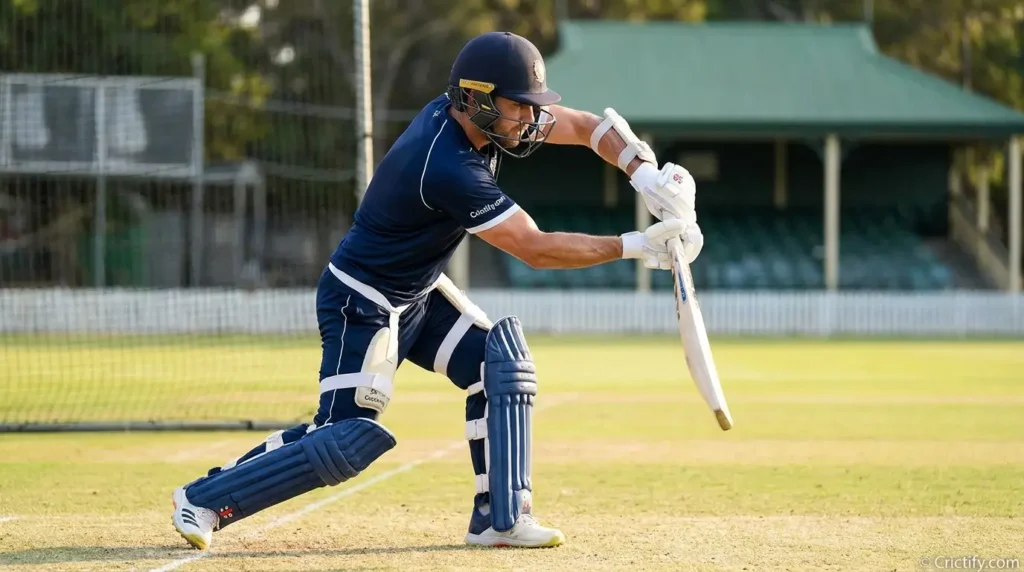
Batters
Main wrist demands: Grip, bat control, repeated impact, vibration, forearm rotation, and late adjustments.
Risk factors: Long net sessions, excessive grip pressure, sudden changes in bat setup, fatigue, and returning before impact tolerance is restored.
Prevention: Build batting volume progressively, vary practice intensity, review grip comfort, and strengthen the forearm and hand.
Return considerations: Test defensive shots, drives, cuts, pulls, mishits, and repeated ball exposure.
Fast Bowlers
Main wrist demands: Hand positioning and release within a high-speed kinetic chain.
Risk factors: Workload spikes, fatigue, altered mechanics, and trying to maintain pace when capacity is reduced.
Prevention: Monitor bowling volume and coordinate wrist rehabilitation with whole-body bowling mechanics.
Return considerations: Progress intensity, delivery count, spell length, and match simulation.
Spin Bowlers
Main wrist demands: Wrist position, forearm rotation, finger action, and variations.
Risk factors: Repetitive release practice, forceful wrist action, and abrupt increases in variation volume.
Prevention: Strengthen the forearm progressively and avoid relying on one small joint to generate all spin.
Return considerations: Restore control of standard deliveries before adding high-demand variations.
Wicketkeepers
Main wrist demands: Repeated catching, glove impact, extension, rotation, and diving.
Risk factors: High catch volume, awkward reaches, hand-first landings, and prolonged sessions.
Prevention: Progress catching volume, review glove fit, and train safe diving and landing mechanics.
Return considerations: Rebuild stationary catching before lateral movement, unpredictability, and diving.
Fielders
Main wrist demands: Catching, throwing, ground contact, and rapid reaction.
Risk factors: One-handed catches, boundary throws, diving, and fatigue.
Prevention: Combine hand strength with whole-body movement and progressive throwing exposure.
Return considerations: Include the actual demands of the player’s fielding position.
Junior Cricketers
Main wrist demands: Developing coordination, technique, grip, and tolerance for repeated practice.
Risk factors: Rapid growth, excessive volume, poor supervision, early specialization, and reluctance to report symptoms.
Prevention: Prioritize skill quality, age-appropriate loading, recovery, and early communication.
Return considerations: Parents, coaches, and healthcare professionals should consider growth, school commitments, training volume, and the child’s ability to describe symptoms.
Professional Cricketers
Main wrist demands: High repetition, high speed, match pressure, travel, and dense schedules.
Risk factors: Limited recovery, playing through pain, rapid return requirements, and cumulative exposure.
Prevention: Use monitoring, individualized conditioning, technical support, and early medical review.
Return considerations: Include role-specific testing, match simulation, fatigue, and confidence under pressure.
Wrist Injuries in Young Cricketers
Young players require particular care because bones, growth plates, muscles, and coordination are still developing.
Persistent wrist pain after a fall, ball impact, batting, or repetitive training should be assessed by an appropriately qualified healthcare professional. A child should not be encouraged to hide symptoms or continue simply because an important match is approaching.
Warning signs in young cricketers include:
- Pain that returns every session.
- Pain that changes technique.
- Swelling after practice.
- Avoidance of gripping or catching.
- Reduced performance because of discomfort.
- Pain at rest or at night.
- Pain after a direct impact.
- Repeated symptoms despite reduced training.
Coaches should avoid using pain tolerance as a measure of commitment. Young players need appropriate technique, sensible volume, rest days, and a supportive environment in which reporting symptoms is encouraged.
Can Bat Grip and Equipment Affect Wrist Stress?
Equipment can influence how a player holds and controls the bat, but no bat, handle size, grip, or accessory universally prevents wrist injury.
Consider:
- Grip pressure.
- Handle comfort.
- Bat weight.
- Balance and pickup.
- Vibration after mishits.
- Player strength and skill.
- Previous injury.
- Technical preferences.
- Fatigue during long innings.
A grip that is too tight may increase forearm fatigue. A bat that feels too heavy may alter control, although the correct choice depends on the individual rather than a universal rule.
After injury, a player may temporarily need a modified setup that allows comfortable control. Any change should be tested progressively in practice rather than introduced immediately in a match.
Cricket-Specific Wrist Warm-Up
A warm-up should prepare the entire upper limb, not just rotate the wrist repeatedly.
A practical progression may include:
- General movement to raise body temperature.
- Shoulder and upper-back mobility.
- Elbow movement.
- Gentle wrist flexion and extension.
- Controlled wrist circles if comfortable.
- Forearm pronation and supination.
- Light grip preparation.
- Progressive bat handling.
- Gentle catching.
- Short throwing.
- Gradual increases in batting or bowling intensity.
Warm-up should not force painful range or create fatigue before the main session. If a player repeatedly needs extensive warm-up to make the wrist tolerable, that pattern deserves assessment rather than endless preparation.
Strength Training for Wrist Injury Prevention
Wrist health depends on the capacity of the hand, forearm, elbow, shoulder, trunk, and lower body to work together.
A balanced program may include:
- Wrist flexors.
- Wrist extensors.
- Forearm pronators.
- Forearm supinators.
- Finger and thumb muscles.
- Grip.
- Elbow flexors and extensors.
- Shoulder rotator cuff.
- Scapular stabilizers.
- Trunk control.
- Lower-body strength for whole-body movement.
The purpose is not to make the wrist rigid. Cricket requires controlled mobility as well as stability. A player needs enough strength to absorb and produce force while retaining the movement required for bat control, ball release, catching, and throwing.
Strength should be progressed through resistance, repetitions, speed, and cricket-specific positions. It should not be measured only by the ability to squeeze a heavy device.
Nutrition, Hydration, Sleep and Recovery
Adequate energy intake supports training, recovery, and general health. Protein contributes to tissue repair and muscle maintenance, while carbohydrates help support training demands. Micronutrients are also important when intake is inadequate or deficiency is present.
Hydration supports performance and concentration, but hydration alone does not heal a fracture, ligament injury, or tendon problem.
Recovery also includes:
- Sufficient sleep.
- Rest between high-load sessions.
- Managing tournament congestion.
- Eating regularly.
- Addressing illness and fatigue.
- Reporting symptoms early.
- Scheduling lighter training after intense exposure.
A player who is under-recovered may lose technical control and place more stress on the wrist even if the original training plan was reasonable.
Common Mistakes Cricketers Make
- Playing through worsening wrist pain.
- Ignoring pain after a fall.
- Assuming every wrist injury is a sprain.
- Returning to batting too quickly.
- Returning to throwing too quickly.
- Returning to bowling too quickly.
- Ignoring grip weakness.
- Repeatedly testing a painful movement.
- Copying random exercises from social media.
- Skipping rehabilitation once daily pain improves.
- Increasing workload too quickly.
- Ignoring symptoms that return after every session.
- Using pain medication to mask symptoms and continue full intensity.
- Treating a professional player’s recovery plan as suitable for every athlete.
- Assuming a normal-looking wrist cannot be significantly injured.
Do’s and Don’ts
| Do | Don’t |
|---|---|
| Stop or modify activity when pain is worsening | Don’t repeatedly test the painful movement |
| Protect the wrist after significant trauma | Don’t assume you can rule out a fracture yourself |
| Seek assessment for persistent or concerning symptoms | Don’t label every wrist problem a sprain |
| Progress batting, bowling, and throwing gradually | Don’t return directly to full match intensity |
| Rebuild grip and forearm strength | Don’t use aggressive exercises during an undiagnosed acute injury |
| Monitor symptoms during and after training | Don’t judge readiness only by how the wrist feels at rest |
| Complete the rehabilitation plan | Don’t stop as soon as pain temporarily improves |
| Communicate with coaches and medical staff | Don’t hide symptoms to remain selected |
When Should a Cricketer See a Doctor for Wrist Pain?
Seek prompt medical assessment after:
- Significant trauma.
- A fall onto the hand.
- Severe or worsening pain.
- Major swelling.
- Bruising after impact.
- Visible deformity.
- Inability to move the wrist normally.
- Inability to grip.
- Persistent pain after a ball strike.
- Thumb-side wrist pain after a fall.
- Recurrent swelling.
- Painful clicking or instability.
- Numbness or tingling.
- Weakness that is new or worsening.
- Symptoms that do not improve with sensible activity modification.
- Symptoms that repeatedly return after cricket.
Some fractures and ligament injuries do not look dramatic immediately. A player should not use the absence of deformity as reassurance that the injury is minor.
Return-to-Play Checklist for Cricketers
Return-to-play should be individualized, but useful checkpoints include:
- Pain is controlled during relevant activity.
- Swelling is absent or appropriately managed.
- Wrist movement is adequate for the role.
- Grip strength is sufficient.
- Forearm strength is sufficient.
- Wrist stability is acceptable.
- The player can hold the bat comfortably.
- Batting drills are tolerated.
- Throwing drills are tolerated.
- Catching is tolerated.
- Bowling exposure is tolerated where relevant.
- Wicketkeeping exposure is tolerated where relevant.
- Fielding and ground contact are tolerated where relevant.
- Training volume can be completed without a meaningful flare.
- Match simulation is completed.
- The player has confidence in the wrist.
- Medical or physiotherapy review has occurred when appropriate.
| Return-to-play domain | Practical question |
|---|---|
| Symptoms | Does the wrist remain settled during and after training? |
| Movement | Can the player access the movement required for the role? |
| Strength | Can the player grip, rotate, catch, throw, or bat without meaningful weakness? |
| Stability | Does the wrist remain controlled under progressive loading? |
| Skill | Can the player perform cricket-specific tasks? |
| Repetition | Can the player tolerate repeated efforts? |
| Fatigue | Does function remain acceptable late in a session? |
| Confidence | Does the player trust the wrist without protective hesitation? |
| Match readiness | Has the player tolerated realistic intensity and unpredictability? |
How to Reduce the Risk of Recurrent Wrist Injury
Recurrence prevention begins with completing rehabilitation rather than stopping once everyday pain disappears.
Helpful strategies include:
- Maintain forearm and grip strength.
- Progress batting, bowling, and throwing workloads.
- Avoid sudden spikes in net volume.
- Monitor symptoms after sessions.
- Review technique when pain repeatedly occurs.
- Adapt equipment when appropriate.
- Warm up progressively.
- Respect fatigue.
- Maintain sleep and adequate nutrition.
- Rebuild confidence through staged exposure.
- Address the original cause rather than relying on repeated rest.
- Report recurrent symptoms early.
A wrist that feels comfortable during a short drill may not yet be ready for a long innings, repeated overs, boundary throwing, or a full day of wicketkeeping. Capacity must be tested progressively.
Frequently Asked Questions
1. What causes wrist injuries in cricket?
Wrist injuries may result from falls, ball impact, mishits, repeated gripping, batting, bowling, throwing, catching, diving, or ground contact. The wrist may also become irritated when training volume rises faster than tissue capacity.
2. Why do batters get wrist pain?
Batters repeatedly grip and control the bat while absorbing vibration and impact. Pain may be related to technique, fatigue, high practice volume, a mishit, tendon irritation, a sprain, or another condition. Persistent pain should be assessed rather than assumed to be simple soreness.
3. Can batting cause a wrist sprain?
Yes. A sprain may occur after a sudden forceful mishit, awkward bat impact, excessive wrist movement, or a fall while batting. Repetitive batting can also irritate tissues without causing a classic acute sprain.
4. Can bowlers develop wrist injuries?
Yes. Bowlers may develop symptoms from repeated wrist positioning, forearm rotation, finger action, workload increases, fatigue, or altered mechanics. Spin bowlers and fast bowlers may experience different demands.
5. What does a scaphoid injury feel like?
A scaphoid injury may cause pain or tenderness near the thumb side of the wrist, difficulty gripping or pinching, and pain with wrist movement. Symptoms can be mild, and the wrist may not look obviously broken, so assessment after a fall is important.
6. What is a TFCC injury?
The TFCC is a group of cartilage and connective-tissue structures on the little-finger side of the wrist. Injury may cause pain with gripping, twisting, throwing, or loading the wrist and may be associated with clicking or instability.
7. How long does a wrist injury take to recover?
Recovery depends on the diagnosis, severity, age, treatment, healing, and role-specific demands. A mild load-related problem may improve sooner than a fracture, scaphoid injury, significant ligament injury, TFCC problem, or postoperative condition. Fixed timelines are not reliable for every player.
8. Can I bat with wrist pain?
It is not automatically safe to continue batting with wrist pain. If pain is worsening, follows trauma, affects grip, or changes technique, stop or modify activity and seek appropriate assessment.
9. When should I see a doctor after a wrist injury?
Seek assessment after significant trauma, a fall, severe pain, swelling, bruising, deformity, loss of movement, inability to grip, thumb-side pain after impact, numbness, weakness, or persistent symptoms.
10. Do all wrist injuries need an MRI?
No. Some injuries can be assessed with history, examination, and X-ray. MRI may be considered when soft-tissue injury is suspected, symptoms persist, or initial tests do not explain the player’s limitations.
11. What exercises strengthen the wrist for cricket?
Possible exercises include isometric wrist work, wrist flexion and extension, forearm rotation, grip training, and finger strengthening. Exercise choice depends on the diagnosis and stage of recovery, so aggressive loading is inappropriate for some acute injuries.
12. How should I return to batting after a wrist injury?
Progress from grip testing to shadow batting, light bat movements, controlled throwdowns, gentle nets, faster bowling exposure, full practice, match simulation, and competition. Increase impact, speed, shot range, and repetition gradually.
13. How should I return to throwing after a wrist injury?
Begin with short, gentle throws and progressively increase distance, speed, repetition, and unpredictability. Later stages should include throwing after running or changing direction and the demands of the player’s fielding position.
14. How can young cricketers prevent wrist injuries?
Young players benefit from age-appropriate workloads, sound technique, adequate rest, progressive strength, proper supervision, and early reporting of pain. Persistent symptoms after impact or repetitive training should be assessed.
15. How can I reduce the risk of recurrent wrist injuries?
Complete rehabilitation, maintain grip and forearm strength, progress cricket workloads gradually, review technique, adapt equipment when appropriate, recover adequately, and respond early when symptoms return. Feeling better does not automatically mean the wrist is ready for full match intensity.
Final Thoughts
A wrist injury in cricket can begin with a single fall, a hard ball, an awkward catch, or a mishit. It can also build gradually through repeated batting, bowling, throwing, or wicketkeeping without enough recovery.The most important step is to respect the difference between temporary soreness and a problem that is persistent, worsening, traumatic, or function-limiting. A proper assessment helps distinguish between bone, ligament, tendon, cartilage, joint, and nerve-related problems.Effective rehabilitation should restore movement, grip, strength, stability, confidence, and the ability to tolerate cricket-specific speed and repetition. Return to batting, bowling, throwing, wicketkeeping, and fielding should be progressive rather than based only on a date or a player’s desire to return.For cricketers, the practical rule is simple: protect the wrist when necessary, investigate persistent symptoms, rebuild capacity gradually, and do not confuse pain suppression with recovery.
Medical Disclaimer
This article is for general education and does not replace an examination, diagnosis, or personalised treatment plan from a qualified doctor, sports physician, physiotherapist, hand specialist, or other licensed healthcare professional. Wrist pain in a cricketer may result from problems involving bones, joints, ligaments, tendons, nerves, or other structures, and online information cannot determine the exact cause or severity.
Do not use this article to decide whether to continue playing, take medication, receive an injection, undergo surgery, or return to batting, bowling, throwing, wicketkeeping, fielding, or competition. Seek prompt medical attention after significant trauma, a fall onto the hand, severe or worsening pain, deformity, major swelling, inability to move or grip normally, persistent pain after an impact, numbness, weakness, or other concerning symptoms. Any exercise or return-to-play programme should be adapted to the individual player’s age, injury, medical history, playing role, training load, and clinical findings.