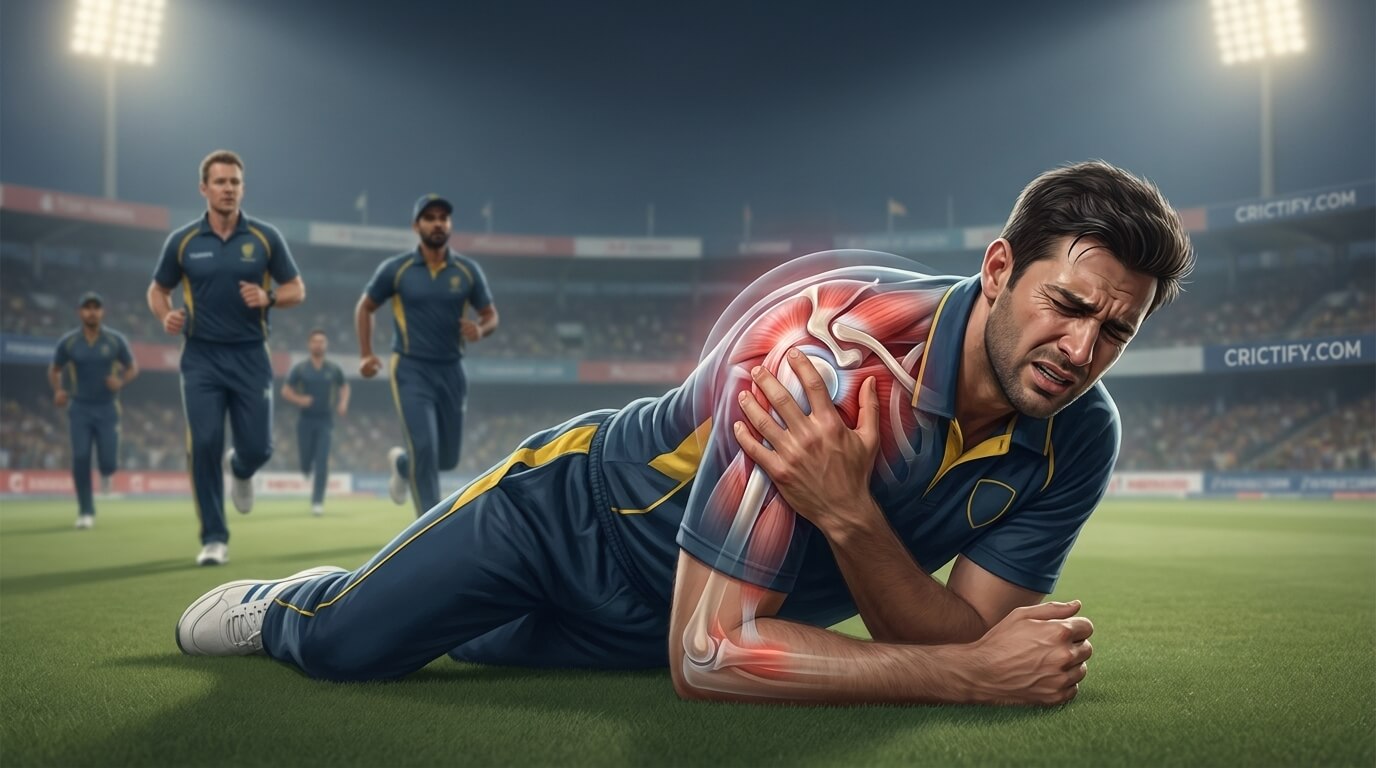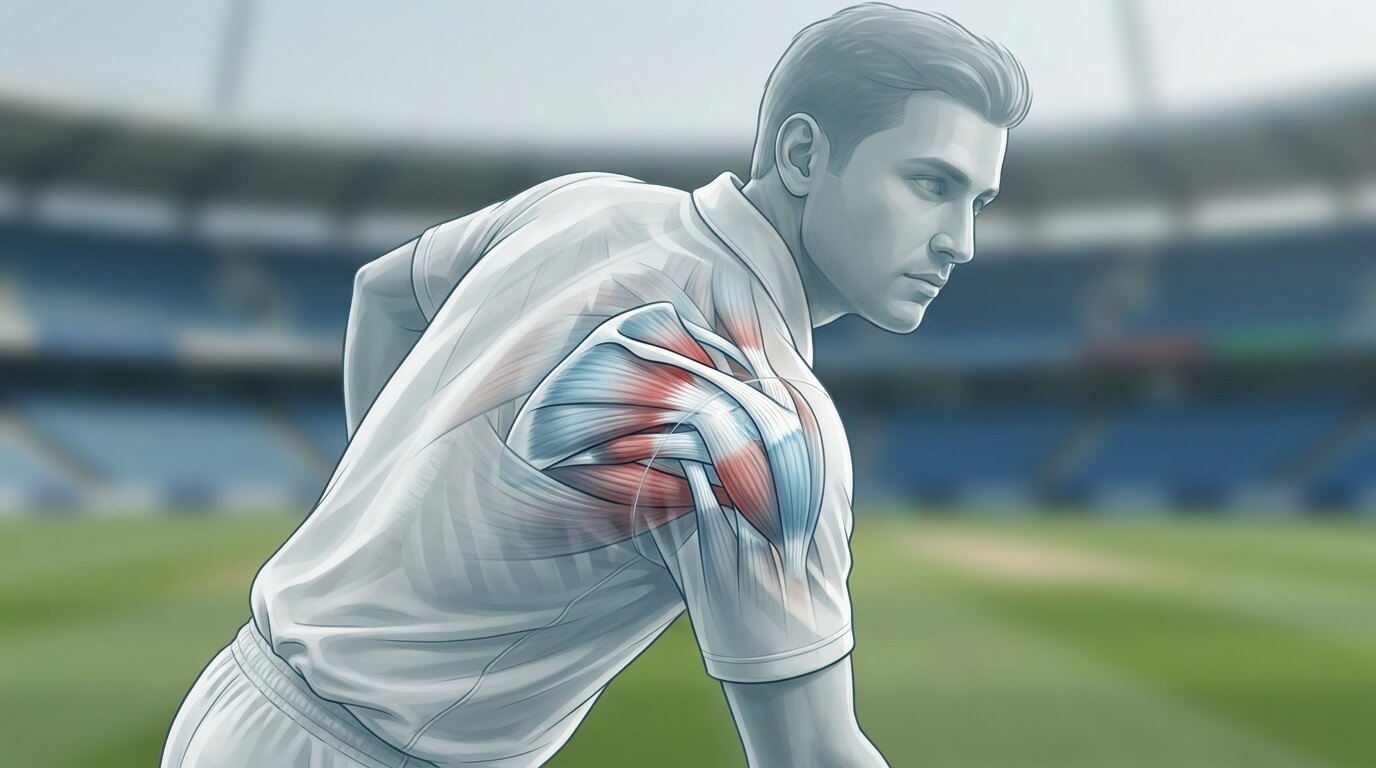
Shoulder impingement syndrome is a common cause of shoulder pain in cricket, particularly during fast bowling, overhead throwing, boundary fielding, wicketkeeping and prolonged batting. It usually develops gradually when the rotator cuff, bursa, shoulder blade and trunk–hip kinetic chain cannot tolerate the volume or speed of overhead activity.
In modern sports medicine, clinicians may describe this problem as subacromial pain syndrome or rotator cuff-related shoulder pain rather than assuming that a tendon is literally being “pinched.” The symptoms can come from irritated rotator cuff tendons, the subacromial bursa, altered shoulder-blade movement, loss of mobility, weakness or excessive workload.
Medical note: This guide is educational and cannot replace an examination by a sports physician or physiotherapist. Sudden weakness, deformity, a traumatic injury, persistent night pain, numbness, fever or inability to raise the arm requires prompt medical assessment.
What Is Shoulder Impingement?
The shoulder is designed for a large range of movement. The ball of the upper-arm bone sits in a shallow socket, while the rotator cuff muscles dynamically centre the ball during bowling, throwing and batting.
The rotator cuff consists of four muscles:
- Supraspinatus.
- Infraspinatus.
- Teres minor.
- Subscapularis.
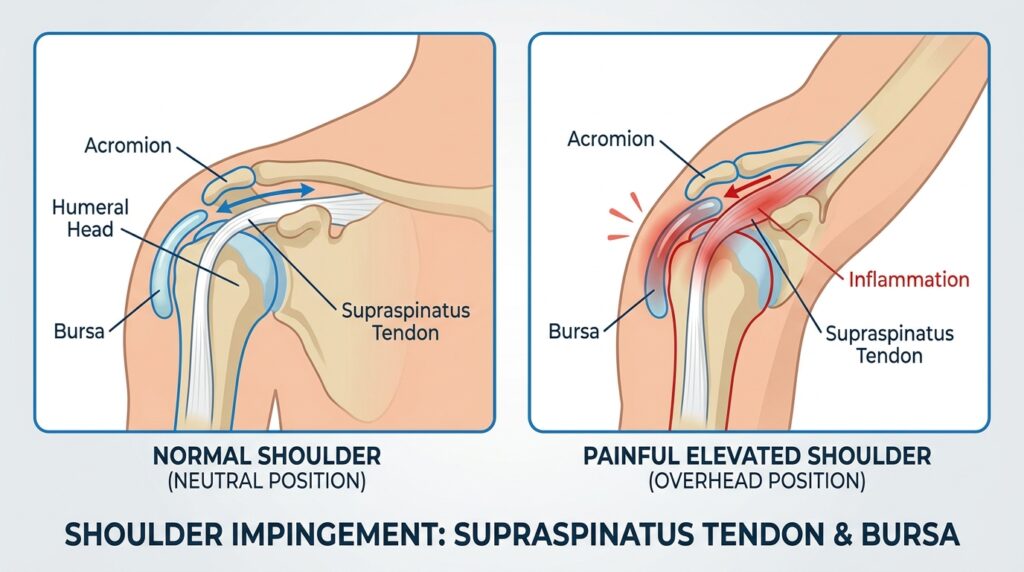
These muscles help rotate the arm and keep the humeral head centred in the socket. Above them is the acromion, part of the shoulder blade, with a fluid-filled subacromial bursa between the acromion and rotator cuff.
When a cricketer repeatedly elevates, externally rotates, accelerates or decelerates the arm, the tendons and bursa may become sensitised. A painful arc—often between approximately 60 and 120 degrees of arm elevation—is common, although not every player follows this pattern.

Impingement and the rotator cuff
Shoulder impingement and a rotator cuff injury are related but not identical.
A cricketer may have:
- Rotator cuff tendinopathy without a tear.
- Bursal irritation.
- A partial-thickness rotator cuff tear.
- A full-thickness tear.
- Labral pathology or shoulder instability.
- Stiffness, scapular dyskinesis or altered thoracic posture contributing to pain.
Repeated overload can irritate the rotator cuff. In turn, pain and weakness may reduce the cuff’s ability to centre the humeral head, increasing abnormal movement during overhead activity. This creates a cycle of pain, altered mechanics, reduced strength and further tendon stress.
Read the related guide: Rotator Cuff Injury in Cricket.
The term “impingement” therefore describes a clinical presentation, not a final diagnosis. A player with similar pain may require a different treatment plan depending on whether the primary problem is tendon overload, a tear, instability, cervical nerve irritation or another condition.
Why It Develops in Cricketers
Shoulder impingement syndrome in cricket is usually a load-management and movement problem, not the result of one delivery. Symptoms often appear after weeks of increased bowling, throwing or fielding.
Bowling biomechanics
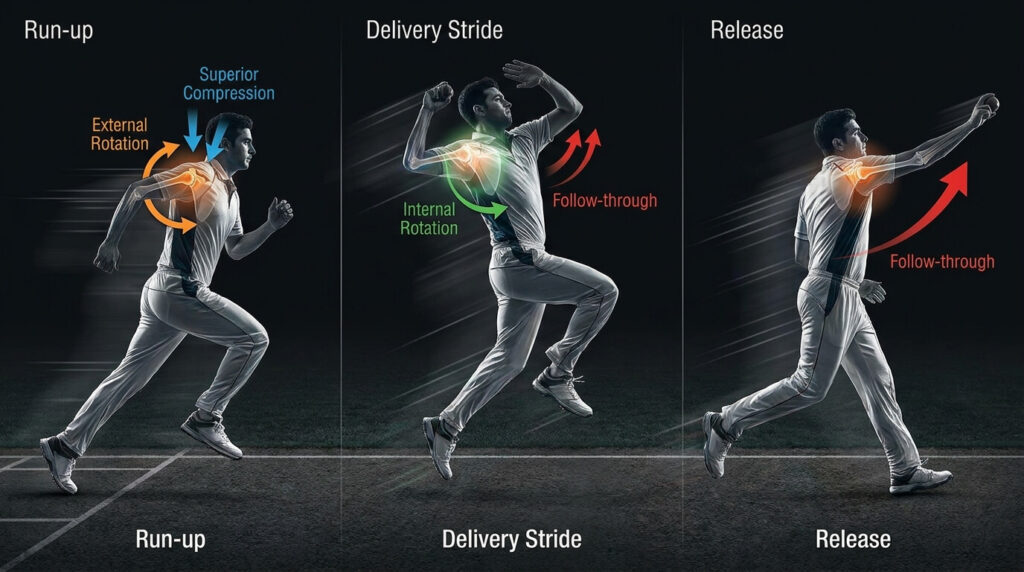
During fast bowling, force should transfer from the run-up through the legs, hips, trunk and shoulder into the ball. The bowling arm passes through high-demand positions involving:
- Shoulder elevation and abduction.
- External rotation during the cocking phase.
- Rapid internal rotation and forward movement during acceleration.
- Eccentric braking by the rotator cuff and scapular muscles.
- Follow-through and deceleration.
The shoulder experiences substantial rotational and compressive forces during the transition from maximum external rotation to ball release. Research on cricket throwing identifies maximum external rotation as a particularly demanding phase, with amateur players in one study showing greater shoulder compression and superior shoulder force than elite players during some throwing conditions.
Fast bowling magnifies the problem because the arm must move rapidly while the bowler is also managing a long run-up, front-leg bracing, trunk separation and repeated high-force deliveries. If the hips and trunk do not contribute effectively, the shoulder may compensate.
Throwing and fielding biomechanics
A boundary throw often begins with a hurried pick-up, a rapid turn, limited footwork and a high-effort release. A fielder may throw from a stationary or awkward position rather than building momentum through the lower body.
Potential stressors include:
- Throwing across the body.
- Poor alignment of the feet and hips.
- Excessive arm-only effort.
- Inadequate follow-through.
- Repeated long throws after a period of low throwing exposure.
- Fatigue late in a spell or innings.
The shoulder is especially challenged when the player reaches maximum external rotation and then rapidly accelerates and decelerates the arm. Cricket research also describes reduced internal rotation, global rotator cuff weakness and scapular-stabiliser weakness as relevant features in some cricketers.
Workload spikes
A workload spike may occur when a player:
- Moves from indoor training to a full outdoor season.
- Bowls several spells after a rest period.
- Adds extra net sessions to match play.
- Plays multiple T20 matches with high-intensity fielding.
- Returns from another injury and compensates with the shoulder.
- Increases throw distance or intensity too quickly.
- Trains bowling, throwing and upper-body strength on consecutive days.
Track more than overs. A useful shoulder workload log includes bowling deliveries, high-intensity throws, overhead catches, wicketkeeping dives, batting duration, gym pressing and pain during the following morning.
Mobility, posture and scapular control
A cricketer may develop:
- Reduced shoulder internal rotation.
- Loss of total rotational range.
- Tightness in the posterior shoulder or pectoralis minor.
- Limited thoracic extension or rotation.
- Poor upward rotation of the scapula.
- Excessive scapular winging or early shrugging.
- Weakness of the lower trapezius, serratus anterior and external rotators.
A stiff thoracic spine can force the arm to move through a less efficient position. A poorly controlled scapula may reduce the platform from which the rotator cuff works. These factors do not automatically cause injury, but they can increase the cost of repeated overhead movements.
Scapular dyskinesis in cricketers
Scapular dyskinesis means altered position or movement of the shoulder blade. It may appear as:
- The shoulder blade lifting away from the ribs.
- Early shrugging during arm elevation.
- Reduced upward rotation.
- Excessive anterior tilt.
- Asymmetry during a wall slide or overhead reach.
It is a movement sign rather than a diagnosis. Pain, fatigue, weakness, thoracic posture and previous injury can all influence it. The aim is not to force the shoulder blade into one “perfect” position; the aim is to restore comfortable, coordinated movement under cricket-specific load.
Symptoms During Cricket
Symptoms vary between players and may change as the season progresses.
Common signs include:
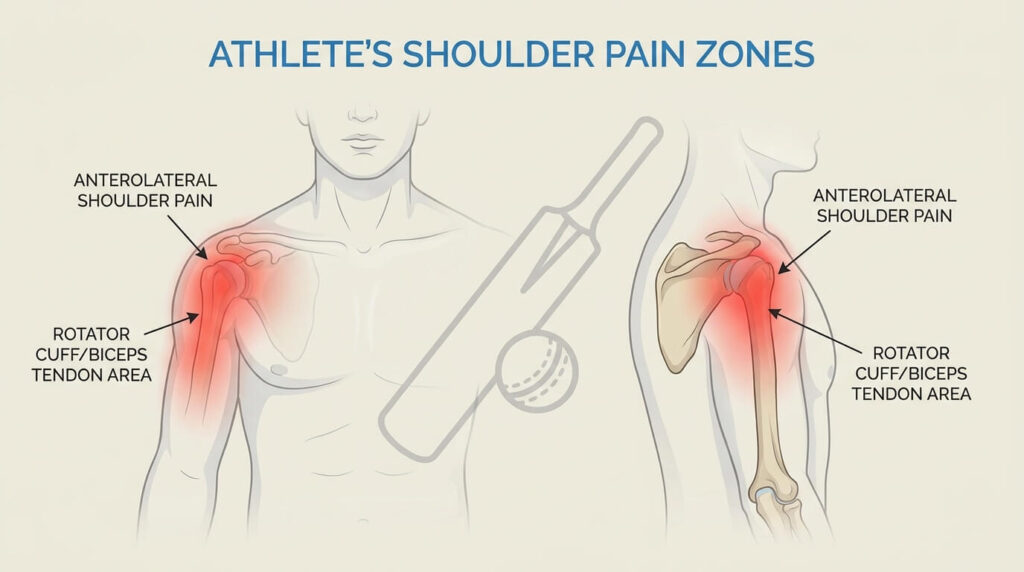
- Pain at the front or outer side of the shoulder.
- Pain when lifting the arm overhead.
- A painful arc while reaching or throwing.
- Pain during the cocking or acceleration phase of bowling.
- Ache after a bowling spell rather than during the first few deliveries.
- Pain reaching back to put on a shirt or fasten a seat belt.
- Night discomfort when lying on the affected side.
- Weakness or loss of bowling pace.
- Reduced throwing distance or accuracy.
- Clicking, catching or a feeling that the arm is not secure.
How pain changes by cricket activity
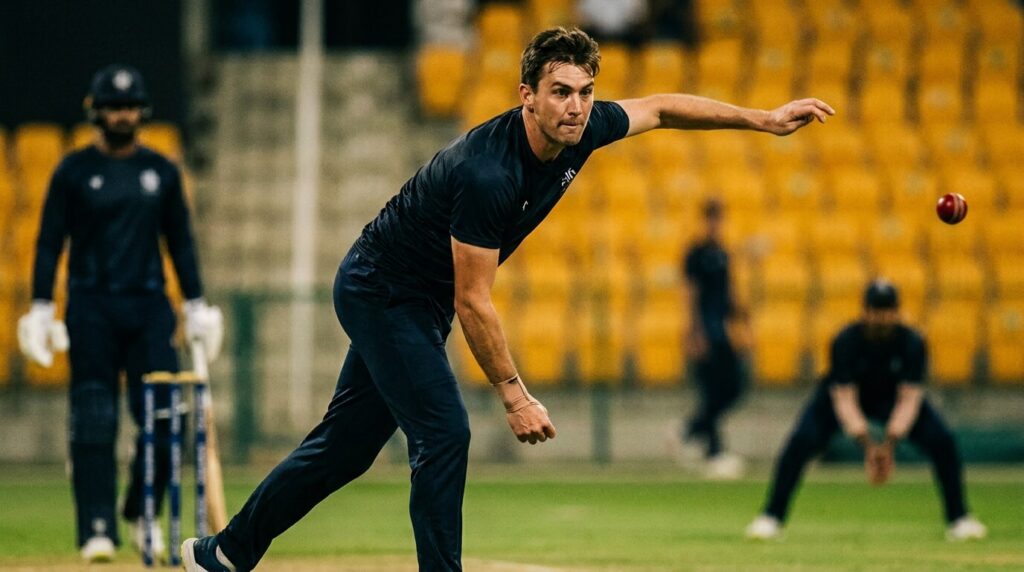
Fast bowling: Pain may begin during the late cocking phase, at release or during follow-through. Some bowlers feel a sharp pinch; others notice a dull ache that increases with each over, reduced pace, loss of control or difficulty completing the action.
Spin bowling: Spin bowlers generally use less shoulder speed than fast bowlers, but repeated revolutions, flighted deliveries, doosras, carrom balls and high-volume net sessions can still overload the shoulder. Pain may appear during repeated arm rotation or after long spells.
Throwing from the boundary: Pain may be most noticeable when the arm travels behind the body and then rapidly comes forward. A player may compensate by throwing with a lower arm slot or across the body.
Overhead catching: Reaching above the head, especially while moving backwards or twisting, can provoke pain. Apprehension, weakness or a sudden inability to catch may suggest a more significant problem than simple subacromial pain.
Long batting sessions: Batting is usually less demanding than bowling or throwing, but prolonged innings can irritate the shoulder through repeated backlift, pull shots, lofted drives, two-handed bat control and protective muscle tension. Holding the bat for hours may also expose pre-existing shoulder stiffness.
Wicketkeeping: Repeated low squats, rising, diving, catching above shoulder height and throwing to the stumps can produce cumulative shoulder load. A keeper may notice pain during rapid releases rather than during the catch itself.
Diagnosis
Diagnosis should combine the history, cricket demands, physical examination and—when indicated—imaging.
A sports clinician may assess:
- The exact phase of bowling or throwing that causes pain.
- Recent changes in overs, sessions, match frequency or throwing distance.
- Previous shoulder, elbow, neck or back injuries.
- Active and passive range of motion.
- Internal and external rotation compared with the opposite side.
- Strength and endurance of the rotator cuff.
- Scapular movement during elevation and resisted tasks.
- Thoracic and hip mobility.
- Cervical spine and nerve function.
- Painful arc, resisted abduction and external rotation.
- Instability, labral or biceps signs.
No single shoulder test proves impingement. Clinical tests can reproduce pain but may not identify the exact tissue responsible.
When imaging is useful
Ultrasound can assess the rotator cuff dynamically and may identify tendon thickening, bursitis or a tear. MRI can show the cuff, labrum, cartilage, bone marrow and other structures. Imaging findings must be interpreted alongside symptoms because asymptomatic athletes can have tendon changes.
Imaging is more likely to be considered when:
- Pain persists despite appropriate rehabilitation.
- There is substantial weakness.
- A traumatic event occurred.
- The player cannot raise the arm.
- There is recurrent instability or catching.
- Symptoms are worsening.
- A significant tear is suspected.
- Return to high-level cricket is being planned after failed conservative treatment.

Treatment
Treatment depends on the diagnosis, severity, workload and playing goals. Most uncomplicated rotator cuff-related shoulder pain is initially managed without surgery.
First stage: settle the irritability
For a painful shoulder:
- Temporarily reduce the movements that clearly provoke symptoms.
- Avoid repeated maximum-effort bowling and throwing.
- Maintain pain-free lower-body and conditioning work.
- Use ice or heat according to personal response.
- Discuss pain medication with a doctor or pharmacist.
- Do not repeatedly test the shoulder with full-speed deliveries.
- Keep gentle, comfortable movement rather than complete immobilisation unless advised.
Relative rest does not mean stopping all cricket. It means reducing the specific dose that exceeds the shoulder’s current capacity.
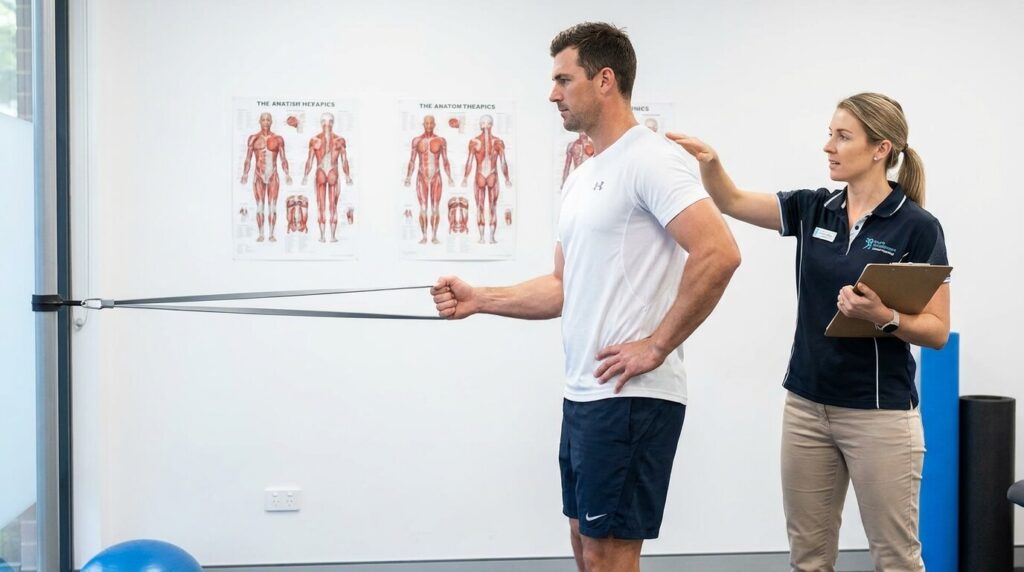
Physiotherapy
A cricket-specific rehabilitation plan may include:
- Pain-limited range-of-motion work.
- Thoracic mobility.
- Posterior shoulder and pectoral flexibility where clinically appropriate.
- Isometric rotator cuff work.
- External and internal rotation strengthening.
- Serratus anterior and lower-trapezius training.
- Scapular control and endurance.
- Closed-chain loading, such as wall or incline push-up variations.
- Trunk, hip and lower-limb strength.
- Progressive medicine-ball and plyometric exercises.
- Bowling and throwing retraining.
A 2025 clinical practice guideline supports active rehabilitation and progressive strengthening for rotator cuff tendinopathy and partial-thickness tears, with return to sport based on function rather than a calendar alone.

Cricket-Specific Rehabilitation
Phase 1: Pain control and movement
Goals:
- Reduce resting and daily-activity pain.
- Restore comfortable elevation.
- Maintain general fitness.
- Avoid painful high-speed bowling and throwing.
- Begin low-load cuff and scapular activation.
Examples may include pendulum movements, supported arm elevation, pain-free isometrics and controlled wall slides. The exact exercise and dosage should match the examination.

Phase 2: Mobility and strength
Goals:
- Restore useful, non-painful shoulder motion.
- Improve internal and external rotation control.
- Build rotator cuff endurance.
- Improve scapular upward rotation and posterior shoulder strength.
- Address thoracic, hip and trunk limitations.

Phase 3: Cricket-specific loading
Progress to:
- Light medicine-ball throws.
- Controlled catch-and-release drills.
- Low-intensity bowling.
- Progressive throwing distance.
- Overhead catching.
- Batting-specific volume.
- Fielding from different positions.
- Fatigue-resistant shoulder circuits.
The shoulder should tolerate each new activity during the session and remain settled later that day and the following morning.
Cricket shoulder exercises
A balanced programme may include:
- Side-lying or banded external rotation.
- Controlled internal rotation.
- Scaption raises in the plane of the scapula.
- Rows and face pulls.
- Serratus wall slides or push-up-plus variations.
- Prone Y, T and W patterns.
- Isometric holds at different arm angles.
- Closed-chain weight shifts.
- Medicine-ball chest passes and rotational throws.
- Trunk and hip exercises that reduce arm-only loading.
Exercise selection should be based on the player’s deficits. More is not always better; excessive strengthening volume can itself aggravate an irritable shoulder.
Role-Specific Advice
Fast bowlers
Fast bowlers face the highest combination of arm speed, external rotation, forceful acceleration and eccentric deceleration. Risk rises when a bowler returns from a break and immediately attempts full spells or maximum pace.
Practical adjustments:
- Reduce overs and intensity separately; do not only reduce overs while bowling every ball at maximum effort.
- Keep early return sessions below match intensity.
- Avoid consecutive high-load bowling days initially.
- Use a gradual increase in deliveries, spell length and pace.
- Monitor next-day symptoms and bowling rhythm.
- Maintain lower-body and trunk strength so the shoulder is not forced to generate the entire delivery.
- Film the action if technique changes, such as early trunk opening or excessive arm-only effort, appear.
Spin bowlers
Spin bowlers may tolerate lower arm speed but accumulate considerable repetition. Shoulder symptoms can develop during long spells, high-volume nets or repeated variations that demand more wrist, forearm and shoulder rotation.
Practical adjustments:
- Limit the number of high-repetition variation deliveries.
- Alternate technical drills with lower-load accuracy work.
- Avoid adding extra net overs immediately before or after matches.
- Build endurance rather than training only maximum force.
- Review whether a stiff thoracic spine or trunk position is causing excessive shoulder rotation.
Batters
Batters may experience pain during:
- Repeated backlift and preparation.
- Pull and hook shots.
- Lofted drives.
- Two-handed follow-through.
- Long periods holding the bat.
- Throwing between wickets or fielding after a long innings.
Batters should not assume that a shoulder is “resting” simply because they are not bowling. Modify shot volume, avoid repeated painful lofted shots and include shoulder breaks during long sessions.
Wicketkeepers
Keepers repeatedly catch, rise, dive and release the ball under time pressure. A keeper with shoulder pain should temporarily reduce high, wide takes and maximum-effort throws while maintaining footwork and lower-body conditioning.
Training can progress from:
- Stationary low catches.
- Controlled take-and-release drills.
- Movement-based catches.
- Above-shoulder catches.
- Full-speed stumpings and throws.
Fielders
Fielders should distinguish between low-intensity close catches and high-intensity boundary throws. Start with short, accurate throws using the legs and trunk, then increase distance, speed and movement.
For boundary throwing:
- Align the feet before releasing.
- Use a crow-hop or controlled approach where possible.
- Let the hips and trunk contribute.
- Avoid repeatedly throwing across the body at maximum effort.
- Follow through toward the target.
- Use relay throws instead of forcing every long throw.
Junior cricketers
Young players need particular attention to:
- Sudden increases in overs or match frequency.
- Year-round cricket with no recovery blocks.
- Adult-sized workload expectations.
- Poor technique hidden by enthusiasm.
- Strength and mobility differences during growth.
- Pain being dismissed as normal development.
A junior should not be encouraged to “bowl through” persistent pain to retain selection. Coaches should track total throwing and bowling exposure across school, club, academy and representative teams.
Professional cricketers
Professionals require more precise monitoring, including:
- Ball counts and spell intensity.
- High-intensity throw counts.
- GPS or tracking data where available.
- Strength and range-of-motion trends.
- Match congestion.
- Travel and sleep.
- Selection pressure.
- Individual recovery response.
A player may remain available for low-risk fielding or batting while being restricted from bowling. Return-to-play decisions should be shared between the player, medical team, bowling coach, strength coach and performance analyst.
Can You Continue Bowling?
Sometimes a player can continue modified bowling, but continuing full-speed bowling through worsening pain is unsafe.
A supervised continuation may be reasonable when:
- Pain is mild and does not alter the action.
- There is no sudden loss of strength.
- Symptoms settle by the next morning.
- Accuracy, pace and control remain normal.
- The player has been assessed.
- Volume and intensity are reduced.
Stop bowling and seek assessment when:
- Pain becomes sharp or progressively worse.
- The action changes to protect the shoulder.
- Pace or accuracy drops suddenly.
- The arm feels weak, unstable or dead.
- Pain persists at rest or at night.
- There was a fall, collision or sudden pop.
- The player cannot raise the arm normally.
Pain should not be used as the only guide. Some serious injuries are not initially very painful, while some non-dangerous tendon problems can be quite painful.
Return-to-Bowling Protocol
Return to bowling should be criteria-based rather than based only on “two weeks off” or another fixed timeline. General return-to-sport guidance recommends full, non-painful motion, satisfactory strength and progressive sport-specific loading; overhead athletes often require close comparison of rotational range and functional capacity between sides.pmc.ncbi.nlm.nih+1
A practical progression is:
Stage 1: Dry bowling
Perform the bowling action without a ball at 50–70% effort. Complete 10–20 repetitions with a smooth rhythm and no protective movement.
Stage 2: Short bowling
Bowl from a reduced run-up at approximately 50–60% intensity. Use a small number of deliveries, with generous recovery.
Stage 3: Moderate-intensity bowling
Increase to approximately 60–75% effort while maintaining technique. Add deliveries gradually, not both intensity and volume at once.
Stage 4: Full run-up and controlled pace
Use the normal run-up, but initially avoid maximum pace and long spells. Monitor pain during the session and the following morning.
Stage 5: Match preparation
Progress from short spells to normal spell length, then simulate match demands, including recovery between spells and fielding.
Stage 6: Return to competition
Return when the player can complete match-specific bowling, fielding and recovery demands without pain, weakness, loss of control or next-day flare-up.
Useful clearance markers include:
- Full or functionally adequate non-painful range of motion.
- No significant strength deficit compared with the other side or the player’s baseline.
- Good scapular control under fatigue.
- Pain-free or near-pain-free sport-specific drills.
- No compensatory bowling action.
- Successful completion of planned bowling loads.
The treating clinician should adjust the protocol for a partial tear, postoperative shoulder, instability, adolescent athlete or recurrent injury.
Return-to-Fielding Protocol
Fielding can be progressed independently from bowling.
- Close catching: Two-hand catches below shoulder height.
- Short throws: Gentle throws over a short distance.
- Moving catches: Add lateral movement and low pickups.
- Longer throws: Increase distance while retaining accuracy.
- Overhead catches: Add high takes and awkward body positions.
- Boundary simulation: Combine sprinting, pickup, crow-hop and throw.
- Match simulation: Include repeated efforts and fatigue.
Do not progress to maximum boundary throws simply because short catches are comfortable. Throwing distance, speed, footwork, body position and repetition count all matter.
Prevention During a Cricket Season
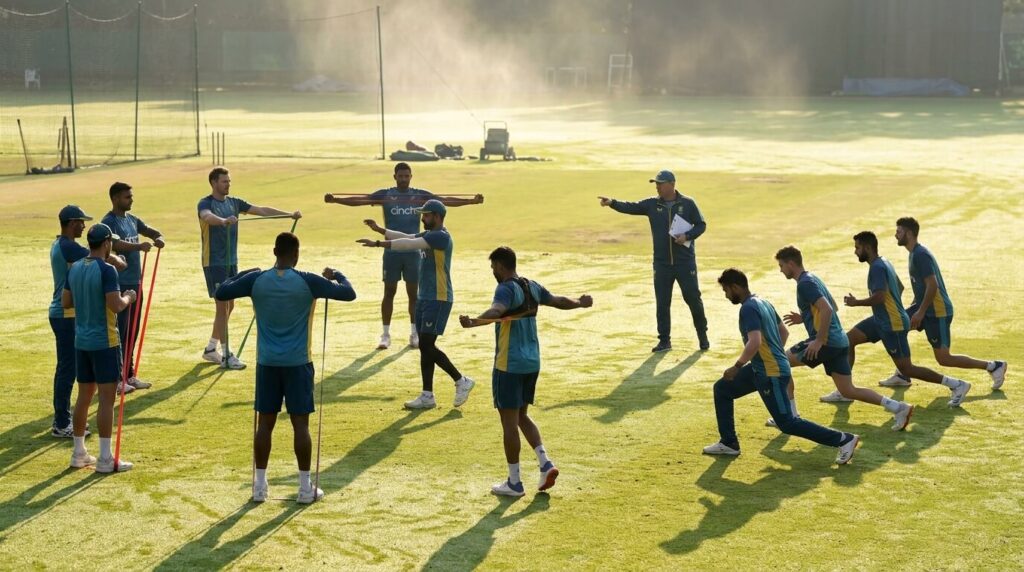
A prevention plan should run throughout the season, not only after pain begins.
Before training
Use 10–15 minutes of progressive preparation:
- Light running or skipping.
- Thoracic rotation and extension.
- Controlled arm circles.
- Scapular activation.
- Low-load external rotation.
- Progressive throwing from short to longer distances.
- Submaximal bowling before full pace.
During the week
- Separate heavy bowling and heavy throwing where possible.
- Avoid sudden increases in total overhead volume.
- Include rotator cuff and scapular strength two or three times weekly, adjusted for match load.
- Maintain lower-body, trunk and hip strength.
- Protect sleep, nutrition and recovery.
- Record pain and next-day response.
- Schedule lower-load technical sessions after high-intensity matches.
Technique and workload
The safest technique is not identical for every player. Coaches should look for:
- Efficient run-up and lower-body contribution.
- Stable trunk control.
- Appropriate front-leg and hip involvement.
- Smooth arm acceleration and deceleration.
- A follow-through that dissipates force.
- Throwing mechanics that use the legs and trunk.
- No obvious late-session collapse in posture or scapular control.
Workload monitoring is most useful when it changes decisions. If a player reports increasing next-day pain, reduce the next exposure rather than waiting for a complete injury.

Recovery Time
Recovery varies considerably.
| Problem pattern | Typical expectation |
|---|---|
| Mild, recent overload | Symptoms may improve over days to several weeks after load modification |
| Rotator cuff tendinopathy or subacromial pain | Often requires several weeks of progressive rehabilitation |
| Persistent or recurrent symptoms | May require a longer structured programme and further assessment |
| Partial-thickness tear | Rehabilitation may take several months depending on symptoms and function |
| Full-thickness tear, instability or surgery | Return may take many months and must be individually supervised |
These are broad planning ranges, not promises. A player who returns when daily pain has improved but cannot tolerate bowling load is not fully recovered.
A clinical review of return-to-play literature found that pain-free motion, strength, functional performance and sport-specific testing are more meaningful than time alone.pmc.ncbi.nlm.nih+1
When to See a Sports Doctor

Arrange an assessment if:
- Symptoms last more than a few weeks despite reducing provoking load.
- Pain repeatedly returns when bowling resumes.
- There is weakness, loss of range or night pain.
- The shoulder clicks with catching or throwing.
- The player feels instability or apprehension.
- Pain follows a collision, fall or sudden force.
- The player is a junior, professional or scholarship athlete with selection pressure.
- Bowling speed, throwing distance or batting performance has changed.
Return to Cricket Checklist
A cricketer is more likely to return safely when they can:
- Perform daily activities without meaningful pain.
- Elevate and rotate the shoulder comfortably.
- Demonstrate good scapular control.
- Complete cuff and shoulder endurance work.
- Catch at increasing heights.
- Throw short, medium and long distances accurately.
- Bowl progressively from reduced intensity to match intensity.
- Bat for the planned duration without a flare-up.
- Recover by the next morning.
- Maintain the action without compensation.
Final Takeaway
Shoulder impingement syndrome in cricket is usually a capacity problem involving the rotator cuff, scapula, mobility, technique and workload. Fast bowlers are exposed to the greatest arm speed and force, but spin bowlers, batters, wicketkeepers and fielders can all develop shoulder pain through repeated overhead or sustained activity.
The best approach is not simply to rest until the pain disappears. It is to identify the cricket-specific load that exceeds capacity, settle the shoulder, restore mobility and strength, rebuild throwing and bowling tolerance, and return through measurable stages. When symptoms persist, recur or include weakness and instability, assessment by a sports physician or physiotherapist is the safest route.