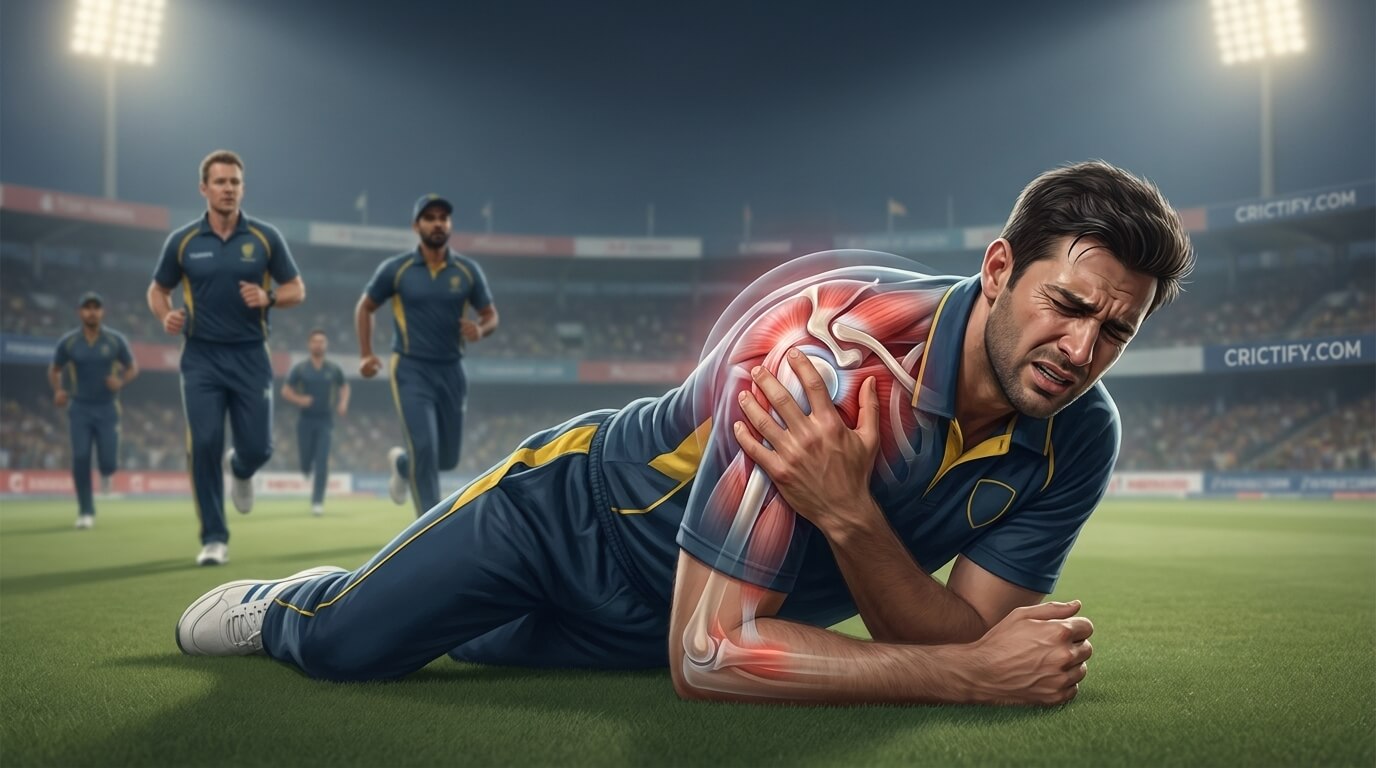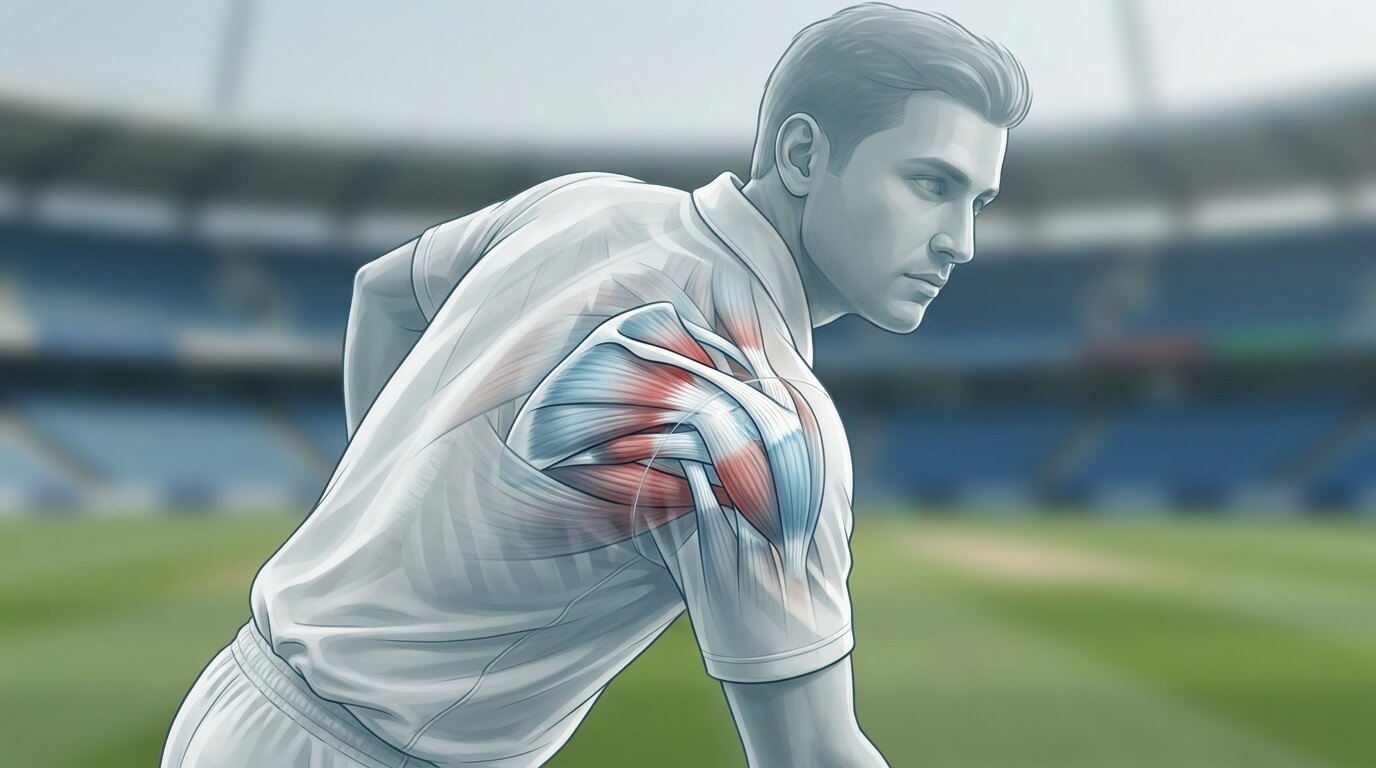
Deep shoulder pain during bowling, throwing, or fielding could signal a labrum tear—one of the most serious shoulder injuries affecting cricket players at all levels. This comprehensive guide explains everything cricket players need to know about labrum tears and SLAP tears, from anatomy and causes to diagnosis, treatment, surgery, rehabilitation, and return-to-cricket protocols.
What is a Labrum Tear?
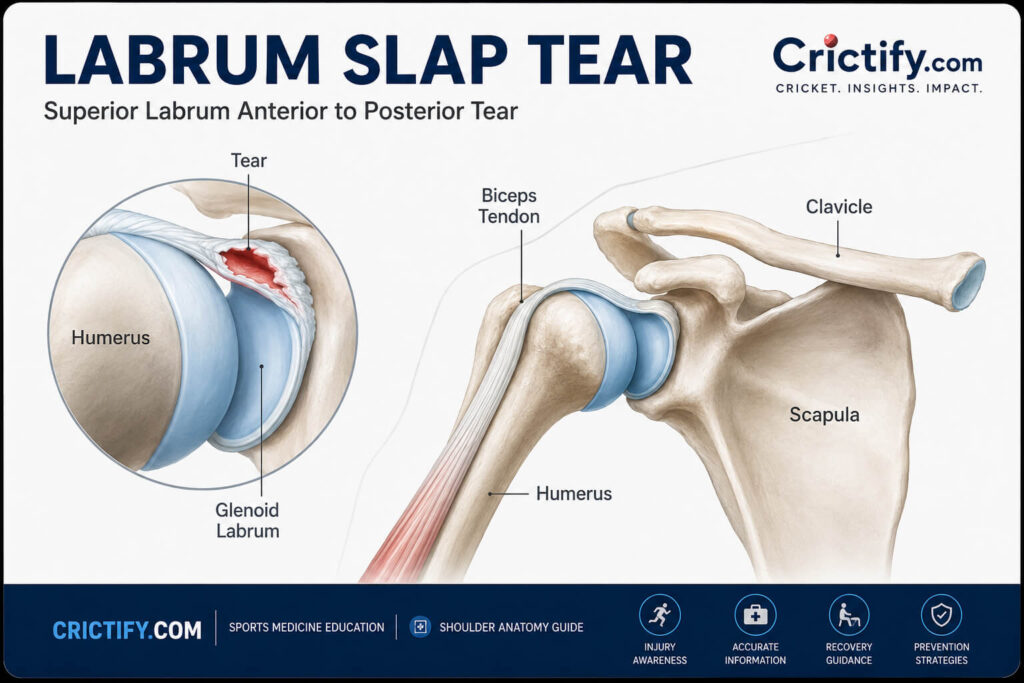
The shoulder labrum is a thick ring of fibrocartilage attached to the rim of the glenoid (shoulder socket) that deepens the socket and provides stability to the glenohumeral joint. When this cartilage tears, it’s called a labrum tear.

Glenoid Labrum Anatomy
The glenoid labrum serves three critical functions:
- Deepens the glenoid fossa by approximately 50%, improving joint stability
- Provides attachment for the glenohumeral ligaments (superior, middle, inferior)
- Anchors the long head of biceps tendon at the superior aspect
The labrum is contiguous with the biceps tendon and forms what’s known as the biceps-labral complex (BLC). Approximately 50% of biceps tendon fibers arise from the superior glenoid labrum, with the remainder attaching to the supraglenoid tubercle.
Superior Labrum and Biceps Tendon Attachment
The superior portion of the labrum—where the biceps tendon attaches—is particularly vulnerable in overhead athletes like cricketers. This region is known as the biceps anchor and represents the first zone of the biceps-labral complex.
The biceps tendon attachment pattern varies:
- Type I: Entire biceps tendon attaches to posterior labrum
- Type II: Most fibers attach to posterior labrum, small portion to anterior
- Type III: Equal contributions to anterior and posterior labrum
- Type IV: Most fibers attach to anterior labrum
Understanding this anatomy is crucial because SLAP tears specifically involve this superior labral-biceps attachment zone.
What is a SLAP Tear?
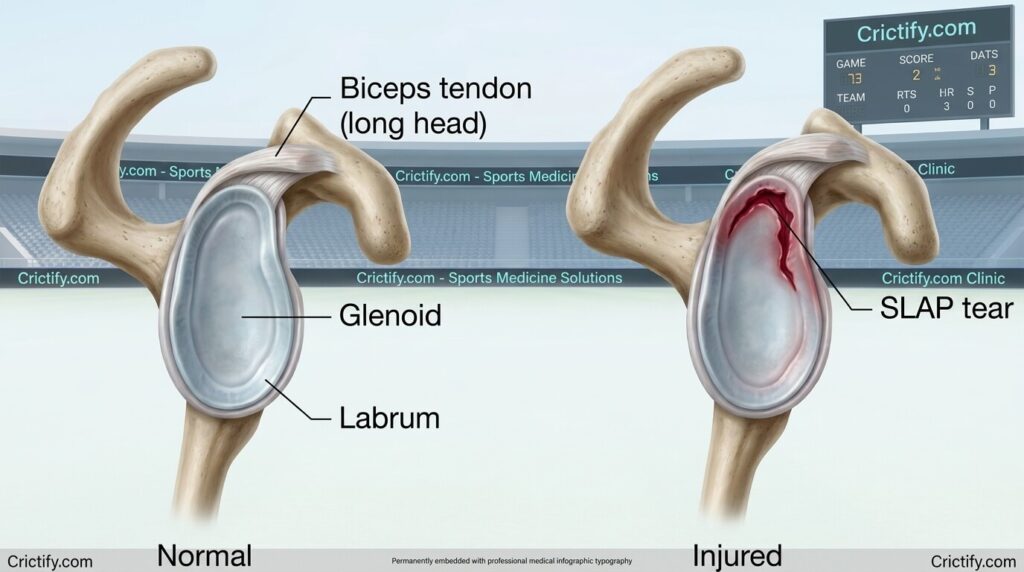
SLAP stands for Superior Labrum Anterior to Posterior. A SLAP tear is a specific type of labral injury that originates at the attachment site of the long head of biceps tendon and extends from anterior to posterior along the superior labrum.
SLAP lesions were first described by Andrews in 1985, and the term was coined by Snyder, who developed the initial classification system. These injuries are particularly common in overhead athletes including cricketers, baseball pitchers, swimmers, and tennis players
Why SLAP Tears Occur in Overhead Athletes
The shoulder must balance mobility versus stability—a paradox particularly relevant to throwing athletes. During overhead activities:
- The shoulder achieves extreme external rotation to generate velocity
- Massive forces transmit through the biceps-labral complex
- Repetitive stress causes microtrauma and eventual tearing
- The “follow-through” phase creates maximal distraction forces on the anterior capsule
In cricket specifically, shoulder injuries are more common during fielding and throwing than bowling, though fast bowlers remain at high risk due to repetitive high-velocity overhead movements.
Types of SLAP Tears
The Snyder classification originally described four types, but the system has since expanded to ten distinct SLAP tear patterns.
| Type | Description | Cricket Relevance |
|---|---|---|
| Type I | Degenerative fraying of superior labrum without biceps detachment | Common in veteran cricketers, often asymptomatic |
| Type II | Detachment of biceps-labral complex from glenoid (most common) | Most frequent in active cricketers, requires surgical consideration |
| Type III | Bucket-handle tear of labrum with intact biceps anchor | Causes catching/locking, may need debridement |
| Type IV | Bucket-handle tear extending into biceps tendon | Often requires biceps tenodesis |
| Type V | SLAP tear + Bankart lesion (anterior-inferior labral tear) | Associated with shoulder dislocation history |
| Type VI | SLAP tear + unstable labral flap | Unstable, symptomatic |
| Type VII | SLAP tear extending into middle glenohumeral ligament | Complex instability pattern |
| Type VIII | SLAP tear + posterior labral tear | Posterior instability component |
| Type IX | SLAP tear + 360° labral tear | Circumferential instability |
| Type X | SLAP tear + rotator cuff tear | Combined pathology, older athletes |
Bankart Lesion vs SLAP Tear
A Bankart lesion is an anterior-inferior labral tear typically associated with anterior shoulder dislocation. When combined with a SLAP tear (Type V), it indicates significant shoulder instability requiring comprehensive surgical stabilization.
Posterior Labral Tears
Posterior labral tears (reverse Bankart lesions) occur less commonly but can result from:
- Posterior shoulder dislocation
- Repetitive posterior loading during follow-through
- Blocking actions in fielding
These may coexist with SLAP tears (Type VIII), creating complex instability patterns.
Labrum Tear vs Rotator Cuff Injury vs Shoulder Impingement
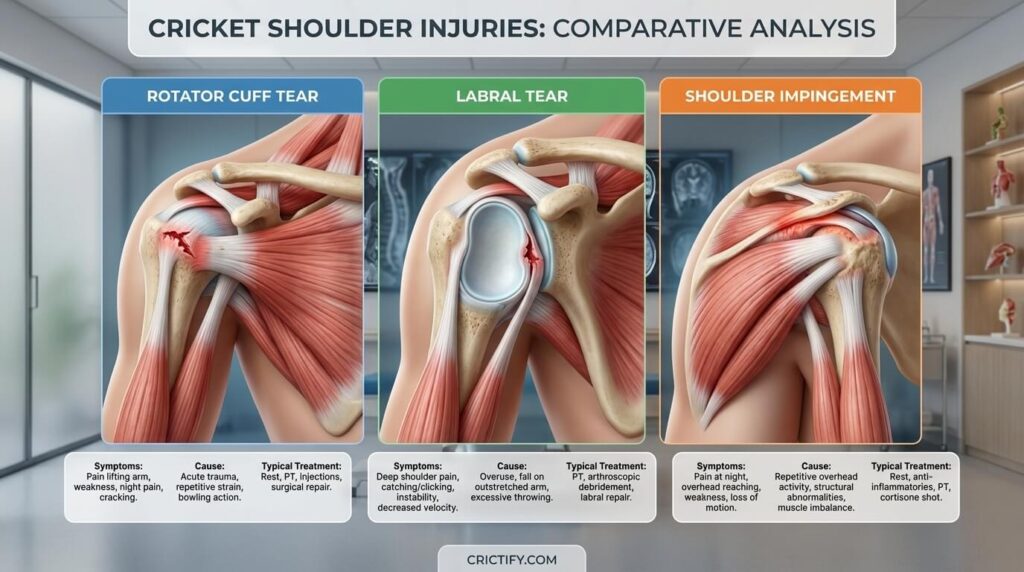
These three conditions frequently coexist in cricketers but affect different structures:
Labrum Tear vs Rotator Cuff Tear
| Feature | Labrum Tear | Rotator Cuff Tear |
|---|---|---|
| Structure affected | Cartilage (labrum) | Muscles/tendons (supraspinatus, infraspinatus, etc.) |
| Primary symptom | Deep pain, clicking, catching, instability | Weakness, pain with overhead activity |
| Age group | Younger athletes (<40) | Older athletes (>40) |
| Physical exam | Clicking, instability tests positive | Weakness with resisted testing |
| Stability contribution | ~20% of shoulder stability | ~70% of shoulder stability |
Key distinction: Labrum tears cause mechanical symptoms (clicking, catching, instability) while rotator cuff tears cause true weakness.
Labrum Tear vs Shoulder Impingement
| Feature | Labrum Tear | Shoulder Impingement |
|---|---|---|
| Pain location | Deep shoulder, hard to localize | Lateral shoulder, acromion area |
| Pain quality | Sharp, catching, mechanical | Gradual, aching, activity-related |
| Mechanism | Cartilage damage, instability | Tendon compression under acromion |
| Special tests | O’Brien’s, Crank, Apprehension | Neer, Hawkins-Kennedy |
| Response to rest | Minimal improvement | Often improves |
Clinical pearl: Pain with full strength suggests impingement; pain with true weakness suggests rotator cuff tear; clicking/catching in young athletes suggests labral pathology.
Relationship Between Conditions
These injuries often coexist in a cascade:
- Labral tear → shoulder instability
- Instability → abnormal humeral head migration (anterosuperior)
- Migration → subacromial impingement
- Impingement → rotator cuff tendinopathy/tear
Understanding this relationship is crucial for comprehensive treatment.
How Labrum Tears Occur in Cricket: Biomechanics and Mechanisms
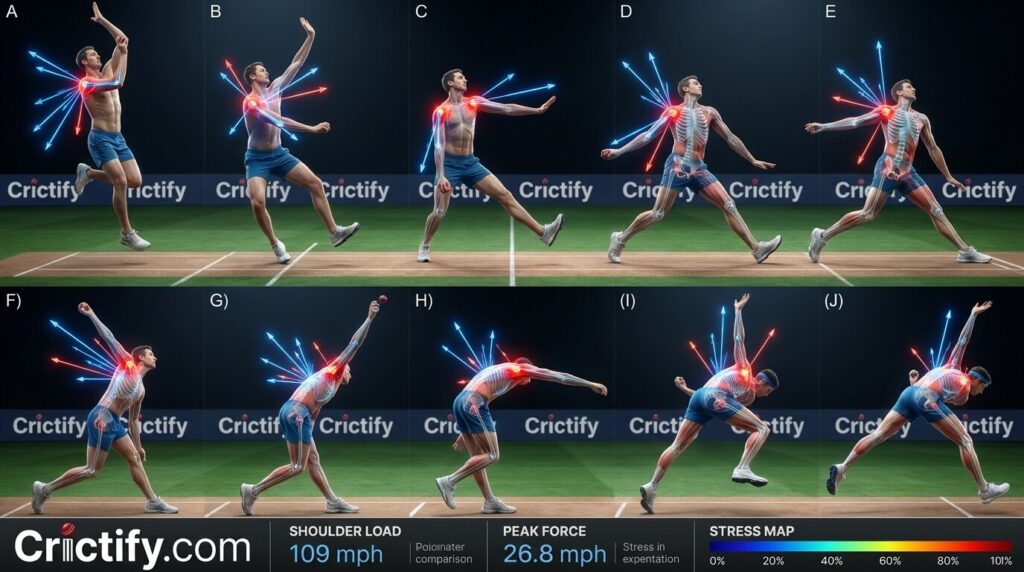
Fast Bowling Biomechanics
Fast bowlers face unique shoulder demands:
Phases of bowling creating labral stress:
- Wind-up: Shoulder begins external rotation
- Late cocking: Maximum external rotation (MER) achieved—most critical point for injury
- Acceleration: Rapid internal rotation (65.2 Nm/kg torque in injured bowlers vs 45.91 Nm/kg in uninjured)
- Follow-through: Quick deceleration with maximal distraction forces at 27° past vertical
Key findings from cricket biomechanics research:
- Spin bowlers and fast bowlers show decreased internal rotation and increased external rotation in dominant shoulders
- Internal rotation torque during acceleration phase is significantly higher in injured bowlers
- Follow-through creates maximal shoulder distraction forces
- Repetitive overhead activity leads to posterior capsule contracture and anterior capsule stretching (“pseudolaxity”)
Throwing from the Boundary
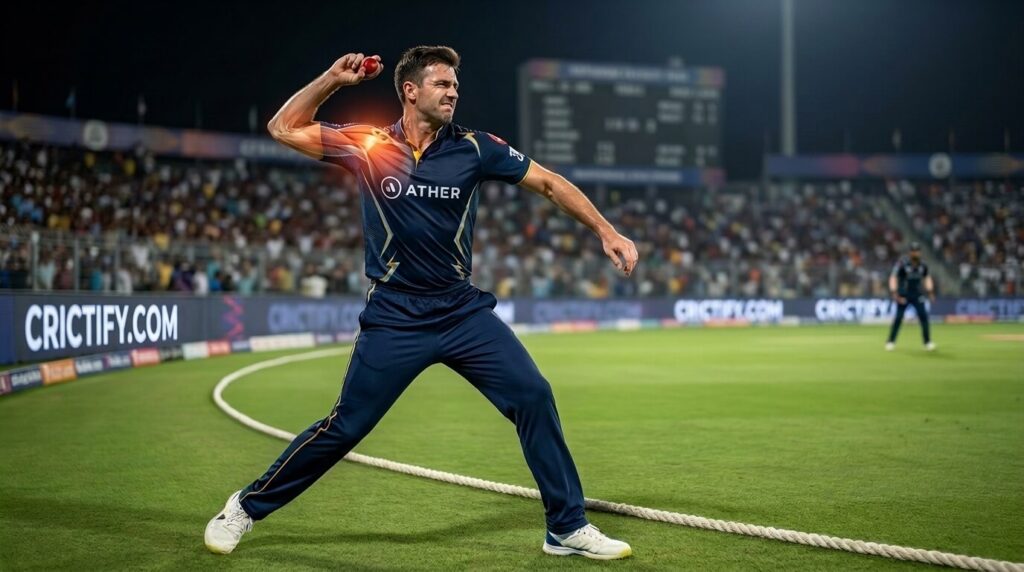
Fielding throws create similar stress to bowling:
Throwing phases:
- Wind-up
- Stride phase
- Arm cocking (maximum external rotation)
- Arm acceleration
- Arm deceleration
- Follow-through
Critical findings:
- Maximum external rotation (MER) is the most injury-prone point
- Amateur cricketers show greater shoulder compression and superior shoulder force at MER compared to elites
- Glenohumeral Internal Rotation Deficit (GIRD) correlates with increased posterior shoulder force
- Stationary throws create more shoulder stress than run-up throws
- Throwing is the primary activity associated with shoulder injury in cricket
Wicket keeping Throws
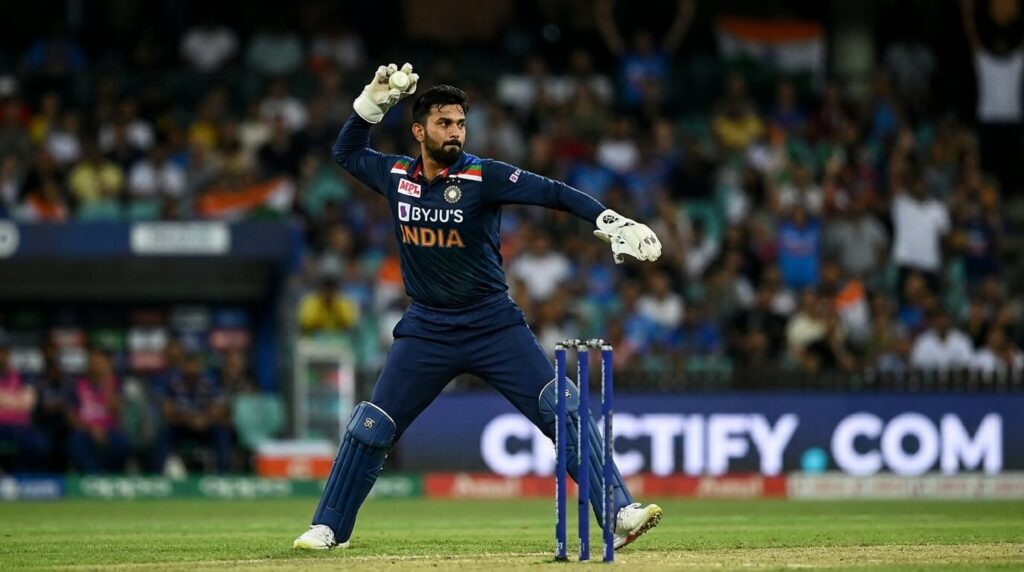
Wicket keepers face unique demands:
- Repeated overhead throws to effect stumpings
- Quick release from crouched position
- Cumulative stress over long innings
- Often throw from stationary position (higher stress)
Diving Catches

Diving catches create acute traumatic mechanisms:
- Outstretched arm absorbs impact
- Sudden traction on biceps-labral complex
- Compression forces through shoulder joint
- Can cause acute SLAP tears or Bankart lesions if dislocation occurs
Repeated Overhead Activity
The cumulative effect of repetitive overhead activity cannot be overstated:
- Energy transfers from lower body → scapula → arm → hand → ball
- Shoulder must balance mobility vs stability (Thrower’s Paradox)
- Repetition produces severe stresses on muscles, bones, and joints
- Posterior capsule contracture + anterior capsule stretching = instability
Cricket Position-Specific Risk Profiles
Fast Bowlers
Risk level: ⚠️⚠️⚠️⚠️⚠️ (Very High)
Fast bowlers face the highest risk due to:
- Repetitive high-velocity overhead movements
- Extreme shoulder external rotation during delivery
- Massive internal rotation torque (65.2 Nm/kg in injured bowlers)
- Follow-through distraction forces at 27° past vertical
- Dual overhead actions (bowling + throwing)
- Loss of bowling speed
- Shoulder clicking during bowling action
- Deep shoulder pain during follow-through
- Reduced endurance in long spells
Spin Bowlers
Risk level: ⚠️⚠️⚠️⚠️ (High)
- Decreased glenohumeral internal rotation (GIRD) in dominant shoulder
- Increased external rotation ROM
- Shoulder injury prevalence: 1.1% (higher than fast bowlers’ 0.9%)
- More shoulder pain than fast bowlers in some studies
Mechanism: Repetitive overhead delivery with extreme external rotation creates cumulative microtrauma.
Batters
Risk level: ⚠️⚠️⚠️ (Moderate)
Batters face shoulder stress from:
- Overhead shots (pull, hook, lofted drives)
- Throwing after running between wickets
- Diving/run-out attempts
- Shoulder injury prevalence: 0.3%
Common presentations:
- Pain during overhead shots
- Difficulty throwing from deep
- Shoulder instability during diving
Wicketkeepers
Risk level: ⚠️⚠️⚠️⚠️ (High)
Wicketkeepers experience:
- Repeated overhead throws for stumpings
- Stationary throwing (higher stress than run-up)
- Cumulative stress over long innings
- Quick release from crouched position
Common presentations:
- Pain during throwing
- Reduced throwing accuracy
- Shoulder fatigue during long innings
Fielders
Risk level: ⚠️⚠️⚠️⚠️ (High)
Fielders face risk from:
- Boundary throws (maximum velocity)
- Diving catches (acute trauma)
- Repetitive throwing throughout match
- Throwing identified as primary shoulder injury activity
Shoulder injury prevalence in fielding: 18% (5% time-loss, 13% non-time-loss)
Junior Cricketers
Special considerations:
- Growth plates still open (apophysitis risk)
- Poor biomechanics common
- Overuse from multiple formats/teams
- Muscle imbalances from rapid growth
- Inadequate recovery between matches
Prevention priority: Technique coaching, load management, strength training.
Professional Cricketers
Special considerations:
- High cumulative load across formats
- Year-round cricket (IPL, international, domestic)
- Previous injury history
- Performance pressure to play through pain
- Complex pathology (combined labral + rotator cuff + impingement)
Management priority: Comprehensive assessment, individualized rehab, return-to-play protocols.
Symptoms: Recognizing a Labrum Tear in Cricket Players
Deep Shoulder Pain in Bowlers
The hallmark symptom is deep, poorly localized shoulder pain:
Characteristics:
- Pain described as “inside the joint”
- Difficult to pinpoint with one finger
- Worse during/after overhead activity
- May radiate to biceps muscle
- Night pain common (sleeping on affected side)
Cricket-specific triggers:
- Pain during late cocking phase of bowling
- Discomfort during follow-through
- Pain when throwing from boundary
- Aching after long fielding sessions
Shoulder Clicking and Instability
Mechanical symptoms distinguish labral tears from other shoulder conditions:
Clicking/Catching:
- Audible or palpable click during bowling
- Catching sensation during throwing
- Locking during overhead movement
- Often painful (vs painless clicking in healthy shoulders)
Instability sensations:
- Shoulder “slipping” during diving catches
- Apprehension during overhead activity
- Feeling shoulder might “pop out”
- Reduced confidence in throwing
Performance Impact
Labrum tears affect cricket performance in multiple ways:
Bowling:
- Loss of bowling speed (reduced velocity generation)
- Inaccurate line/length (pain alters release point)
- Reduced spell length (fatigue, pain)
- Altered bowling action (compensatory mechanics)
Throwing:
- Reduced throwing distance
- Decreased throwing accuracy
- Pain during follow-through
- Reluctance to throw at full intensity
Fielding:
- Difficulty catching overhead balls
- Apprehension during diving
- Reduced agility (protective posturing)
- Avoidance of throwing positions
Batting:
- Pain during overhead shots
- Reduced power in lofted shots
- Discomfort when running between wickets (throwing)
Psychological:
- Loss of confidence in shoulder
- Fear of re-injury
- Performance anxiety
- Reluctance to commit to dives/catches
Diagnosis: Clinical Examination and Physical Tests

Physical Examination Tests
Several specialized tests help diagnose labral tears:
O’Brien’s Active Compression Test:
- Patient forward flexes arm to 90°, adducts 15°
- Internally rotates (thumb down)
- Examiner applies downward force
- Positive: Pain deep in shoulder (reproduces symptoms)
- Specificity: High for SLAP tears
Crank Test:
- Arm elevated to 160° in scapular plane
- Examiner applies axial load + rotation
- Positive: Pain, clicking, or catching
- Sensitive for labral pathology
Apprehension Test:
- Arm abducted to 90°, externally rotated
- Positive: Patient shows apprehension/fear of dislocation
- Indicates anterior instability (Bankart, SLAP)
Speed’s Test:
- Arm forward flexed to 90°, elbow extended, supinated
- Examiner resists forward flexion
- Positive: Pain in bicipital groove
- Indicates biceps tendon pathology (often with SLAP)
Yergason’s Test:
- Elbow flexed 90°, forearm supinated
- Patient resists external rotation + supination
- Positive: Pain in bicipital groove
- Biceps tendon pathology
Load and Shift Test:
- Assesses anterior/posterior translation
- Positive: Excessive translation indicates instability
Differentiating from Other Conditions
Physical examination helps distinguish:
| Test | Labral Tear | Impingement | Rotator Cuff Tear |
|---|---|---|---|
| O’Brien’s | Positive | Negative | Negative |
| Neer’s | Negative/Positive | Positive | Positive |
| Hawkins-Kennedy | Negative/Positive | Positive | Positive |
| Empty Can | Negative | Negative | Positive (weakness) |
| Apprehension | Positive | Negative | Negative |
MRI Findings and MR Arthrogram
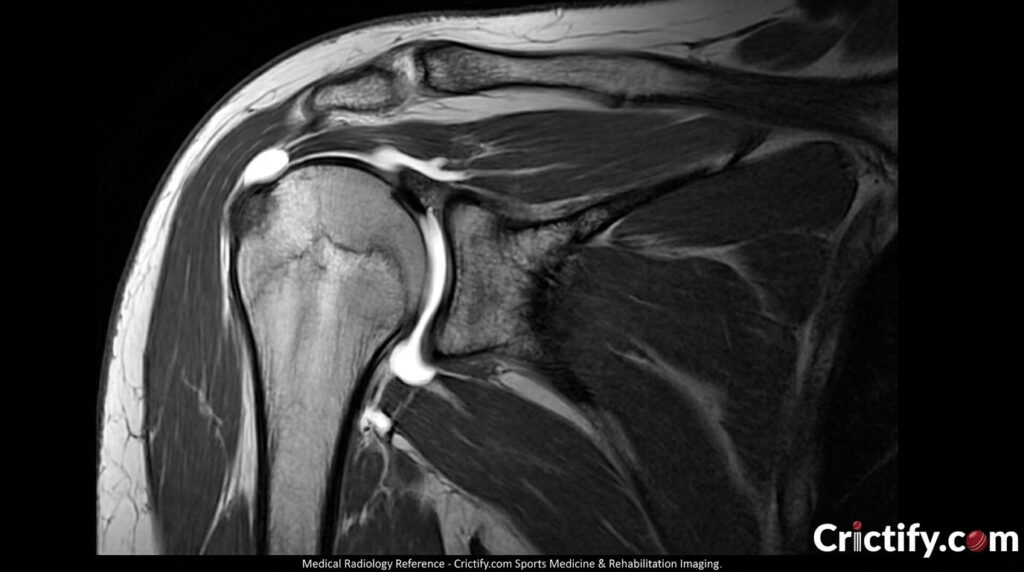
Standard MRI vs MR Arthrogram
Standard MRI:
- Non-invasive
- Good for rotator cuff, bone, soft tissue
- Limited sensitivity for labral tears (especially Type I, II)
- May miss subtle labral pathology
MR Arthrogram (MRA):
- Gold standard for labral imaging
- Intra-articular contrast injection (gadolinium)
- Contrast extends under detached labrum, highlighting tear
- Superior sensitivity for SLAP tears (85-95%)
- Better visualization of biceps anchor
MRI Findings in SLAP Tears
Direct signs:
- High signal (fluid) extending into/under superior labrum
- Contrast undercutting labrum (MRA)
- Labral detachment from glenoid
- Biceps tendon abnormalities (tendinosis, partial tear)
- Paralabral cysts (chronic tears)
Indirect signs:
- Biceps tendon subluxation from bicipital groove
- Glenoid bone abnormalities (cysts, erosion)
- Associated rotator cuff pathology
- Capsular laxity
Imaging Protocol for Cricket Players
Recommended protocol:
- Clinical examination first (history + physical tests)
- X-rays (rule out bone pathology, arthritis)
- MR Arthrogram (gold standard for labrum)
- Standard MRI (if MRA contraindicated)
- CT arthrogram (if bony pathology suspected)
Important: MRI findings must correlate with clinical symptoms. Many asymptomatic players show labral abnormalities on MRI.
Non-Surgical Treatment
Not all labral tears require surgery. Initial management focuses on:
Activity Modification
Cricket-specific modifications:
- Reduce overhead throwing volume
- Limit bowling overs in training
- Avoid painful positions (extreme external rotation)
- Modify fielding positions (avoid deep boundary)
- Cross-training (lower body, core)
Pain Management
- NSAIDs (ibuprofen, naproxen) for inflammation
- Ice after activity (15-20 minutes)
- Activity pacing (avoid consecutive high-load days)
- Corticosteroid injection (if significant inflammation, diagnostic value)
Physical Therapy Foundation
Phase 1 goals:
- Reduce pain and inflammation
- Restore pain-free range of motion
- Begin scapular stabilization
- Maintain lower body and core fitness
Timeline: 6-12 weeks of conservative management before considering surgery
Physiotherapy Rehabilitation

Comprehensive Rehabilitation Approach
Successful rehabilitation addresses all contributing factors:
Assessment components:
- Range of motion (IR, ER, flexion, abduction)
- Strength testing (rotator cuff, scapular muscles)
- Scapular control (winging, dyskinesis)
- Movement patterns (throwing, bowling mechanics)
- GIRD assessment (side-to-side IR difference)
- Core and lower body strength
Scapular Stabilization
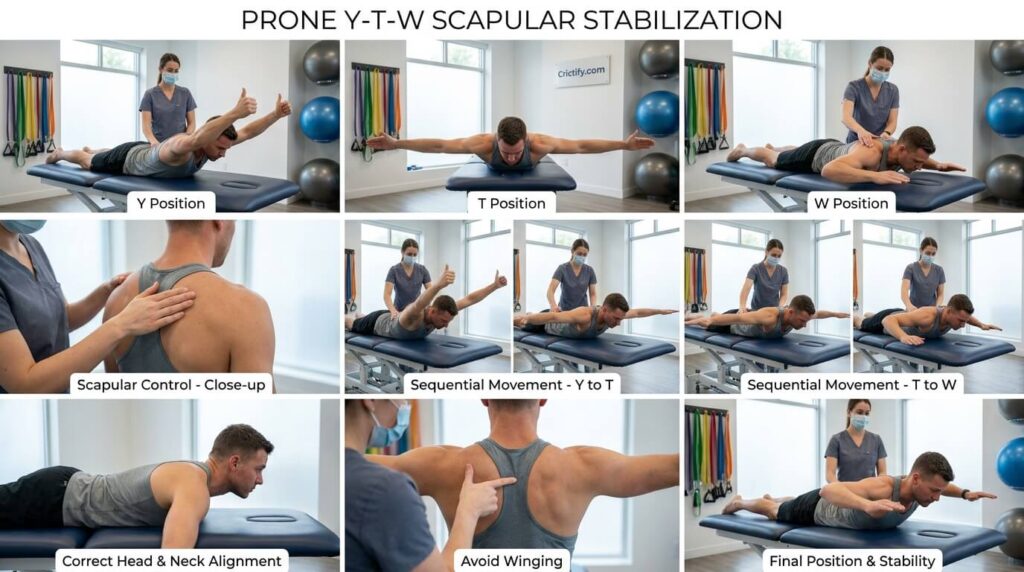
Why it matters: The scapula provides the stable base for shoulder movement. Poor scapular control leads to:
- Abnormal humeral head positioning
- Increased impingement risk
- Reduced throwing efficiency
- Compensatory labral stress
Key exercises:
- Prone Y-T-W raises (lower trapezius, rhomboids)
- Scapular push-ups (serratus anterior)
- Wall slides (scapular upward rotation)
- Rows (middle trapezius, rhomboids)
- Serratus punches (serratus anterior)
- Scapular clock (multi-directional control)
Progression: Isometric → isotonic → dynamic → sport-specific
Rotator Cuff Strengthening
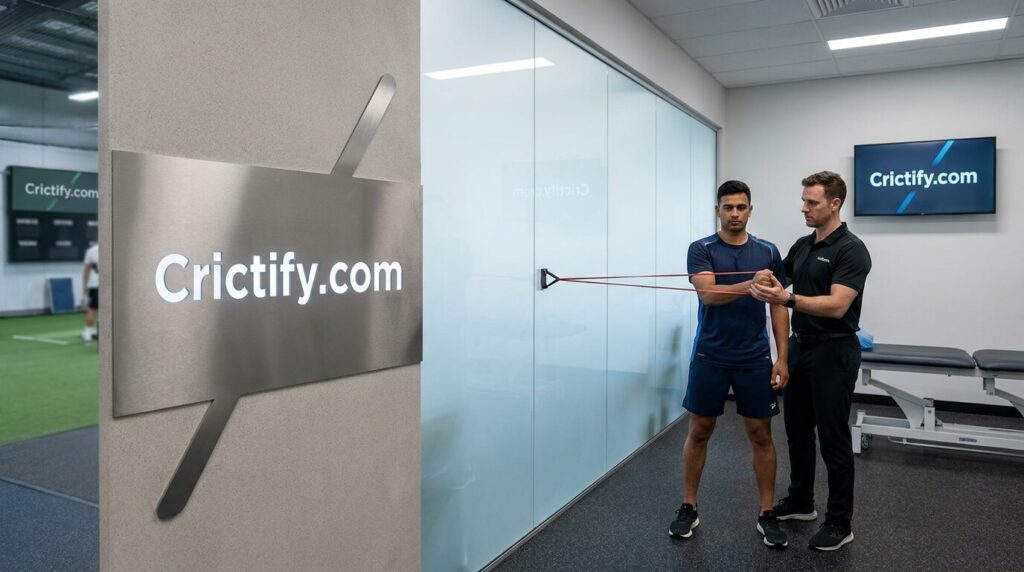
The rotator cuff provides ~70% of shoulder stability (vs labrum’s ~20%). Strengthening these muscles compensates for labral deficiency.
Key exercises:
- External rotation (side-lying, cable, band)
- Internal rotation (controlled, avoid overdevelopment)
- Full can (scaption plane elevation)
- Prone horizontal abduction (posterior cuff)
- 90/90 external rotation (throwing position)
- Eccentric strengthening (deceleration control)
Important principles:
- Quality over quantity (proper form)
- Pain-free range (avoid aggravating positions)
- Progressive loading (gradual resistance increase)
- Eccentric emphasis (deceleration control critical for throwers)
Addressing GIRD (Glenohumeral Internal Rotation Deficit)
GIRD definition: Loss of internal rotation in dominant shoulder compared to non-dominant.
In cricketers:
- GIRD associated with increased posterior shoulder force
- Correlates with reduced hip external rotation
- May contribute to throwing across body mechanics
Treatment:
- Posterior capsule stretching (sleeper stretch, cross-body stretch)
- Soft tissue mobilization (posterior shoulder, latissimus)
- Thoracic spine mobility (extension, rotation)
- Hip mobility work (IR/ER, abduction)
Core and Lower Body Integration
The kinetic chain: Energy transfers from ground → legs → core → shoulder → arm → ball.
Weakness anywhere compromises shoulder function:
- Core stability (planks, dead bugs, Pallof press)
- Hip strength (glute medius, external rotators)
- Leg power (squats, lunges, plyometrics)
- Thoracic mobility (extension, rotation)
Arthroscopic Labrum Repair Surgery

When Surgery is Indicated
Surgical candidates:
- Type II SLAP tears (biceps anchor detachment) in active athletes
- Failed conservative treatment (6-12 weeks of PT)
- Mechanical symptoms (catching, locking, instability)
- High-demand overhead athletes (fast bowlers, elite fielders)
- Combined instability (SLAP + Bankart)
- Young patients (<40 years) with acute tears
Non-surgical candidates:
- Type I SLAP (degenerative, asymptomatic)
- Older patients (>40-45) with degenerative changes
- Low-demand patients (recreational cricket only)
- Significant arthritis (may need alternative procedures)
Surgical Technique: Arthroscopic SLAP Repair
Procedure overview:
- Anesthesia: General + interscalene nerve block
- Positioning: Beach chair or lateral decubitus
- Portal placement: 2-4 small incisions (5-10mm)
- Diagnostic arthroscopy: Camera evaluates entire joint
- Labral preparation: Torn edges debrided, glenoid prepared
- Anchor placement: Suture anchors inserted into glenoid rim
- Suture passage: Sutures passed through labrum
- Knot tying: Labrum reattached to glenoid
- Final assessment: Stability and repair integrity confirmed
- Minimally invasive (small incisions)
- Less pain, faster recovery
- Better visualization of joint
- Lower infection risk
- Outpatient procedure (same-day discharge)
Biceps Tenodesis
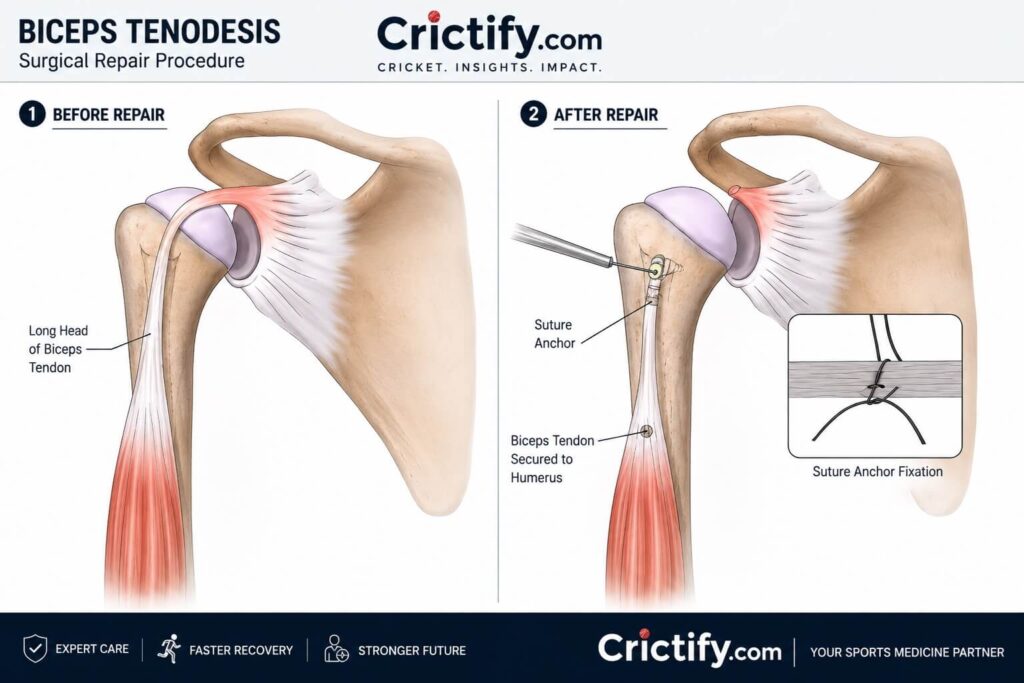
What is it? Biceps tenodesis relocates the biceps tendon attachment from the superior labrum to the humerus (upper arm bone).
Why consider it?
- Eliminates tension on superior labrum
- Preserves biceps function (cosmesis, strength)
- Lower re-tear risk vs SLAP repair
- Better outcomes in patients >35-40 years
Evidence:
- Return to sport rates: Comparable to SLAP repair (78.5% vs 67.7%, p=0.33)
- Overhead athletes: No significant difference (83.6% vs 74%, p=0.82)
- Return to pre-injury level: Slightly better with tenodesis in some studies
- Complication rates: Lower with tenodesis (0% vs up to 21.8%)
- Revision rates: Lower with tenodesis (0% vs 7.5-12.5%)
Current consensus: Biceps tenodesis is not inferior to SLAP repair for overhead athletes and may be preferred in:
- Patients >35-40 years
- Type II SLAP tears
- Biceps tendon pathology
- Revision surgery
- High-demand throwers (some surgeons prefer)
Recovery Timeline After Labrum Surgery

Phase 1: Immobilization (Weeks 0-4/6)
Goals:
- Protect surgical repair
- Control pain and inflammation
- Maintain elbow/wrist/hand motion
- Begin passive shoulder ROM (as permitted)
Restrictions:
- Sling: 4-6 weeks (surgeon dependent)
- No active motion: Let therapy move arm only
- No lifting: Nothing heavier than coffee cup
- No external rotation: Beyond neutral (protects repair)
- No combined abduction + external rotation: Vulnerable position
Phase 2: Range of Motion (Weeks 4/6-12)
Goals:
- Restore full passive ROM
- Begin active-assisted ROM
- Initiate scapular stabilization
- Continue rotator cuff isometrics
Progression:
- Week 4-6: Passive ROM in all planes
- Week 6-8: Active-assisted ROM
- Week 8-12: Active ROM, light strengthening begins
Milestones by week 12:
- Full passive ROM
- Pain-free active ROM
- Good scapular control
- No sling required
Phase 3: Strengthening (Weeks 12-16/20)
Goals:
- Restore rotator cuff strength
- Improve scapular stabilization
- Begin kinetic chain integration
- Progress to sport-specific exercises
Exercises:
- Rotator cuff strengthening (bands, cables, weights)
- Scapular stabilization (Y-T-W, rows, serratus work)
- Core strengthening (planks, anti-rotation)
- Lower body strengthening (squats, lunges)
- Closed-chain exercises (push-ups, planks)
Criteria to advance:
- Full, pain-free ROM
- Good scapular control
- No pain with strengthening
- Adequate rotator cuff strength (at least 4/5)
Phase 4: Return to Throwing/Bowling (Weeks 16/20-24/28)
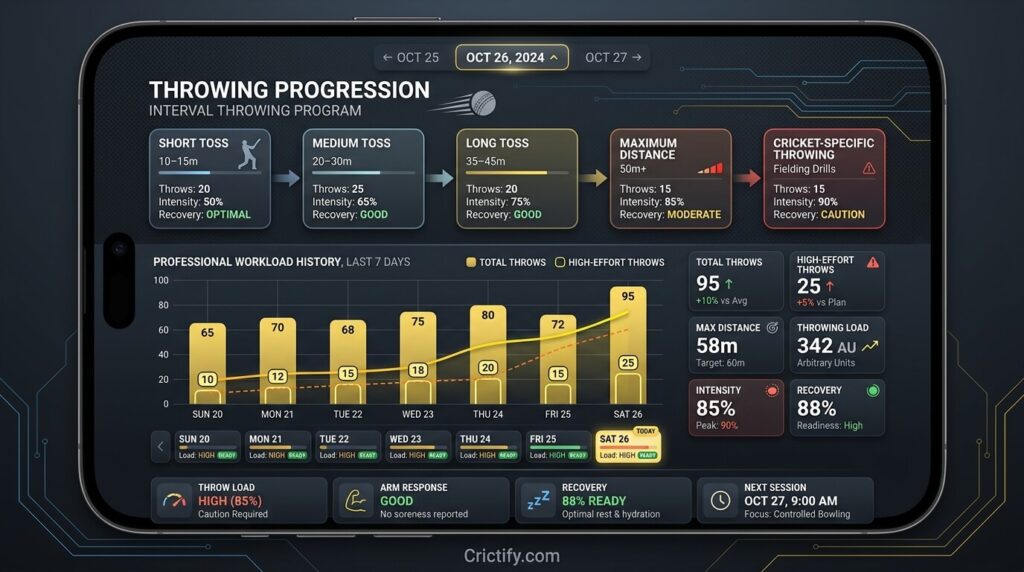
Interval Throwing Program:
Phase 1: Short Toss (Weeks 16-20)
- Distance: 10-15 meters
- Repetitions: 20-30 throws
- Frequency: 2-3x/week
- Focus: Mechanics, pain-free motion
Phase 2: Medium Distance (Weeks 20-24)
- Distance: 20-30 meters
- Repetitions: 30-50 throws
- Frequency: 2-3x/week
- Focus: Building strength, endurance
Phase 3: Long Toss (Weeks 24-28)
- Distance: 40-60 meters (boundary throws)
- Repetitions: 50-75 throws
- Frequency: 2-3x/week
- Focus: Maximum velocity, cricket-specific throwing
Phase 4: Cricket-Specific (Weeks 28-32)
- Wicket keeper throws (stumping simulation)
- Fielding throws (various positions)
- Bowling progression (see below)
- Match simulation drills
Return-to-Bowling Protocol
Fast bowlers:
Week 28-30:
- Jogging progression (straight lines → curves)
- Bowling drills without ball (shadow bowling)
- Core and lower body strengthening
Week 30-32:
- Short run-up, 50% effort (10-12 balls)
- Focus on mechanics, not speed
- Monitor pain and fatigue
Week 32-34:
- Full run-up, 60-70% effort (12-18 balls)
- Build overs gradually
- Add variation (pace, line)
Week 34-36:
- Full run-up, 80% effort (18-24 balls)
- Match simulation (consecutive days)
- Build endurance
Week 36-40:
- Full training (100% effort)
- Practice matches
- Build match fitness
Spin bowlers: Similar timeline but may progress faster due to lower velocity demands.
Return-to-Competition Criteria
Must meet ALL criteria before match play:
- Full functional ROM (equal to non-dominant side)
- No pain or tenderness (rest, activity, palpation)
- No instability signs (apprehension, subluxation)
- Adequate strength (≥90% of non-dominant side)
- Good dynamic stability (scapular control, rotator cuff endurance)
- Successful completion of throwing/bowling progression
- Psychological readiness (confidence in shoulder)
- Surgeon/physio clearance
Typical timeline: 6-9 months for full return to competition
Return to Cricket After Labrum Surgery: What to Expect
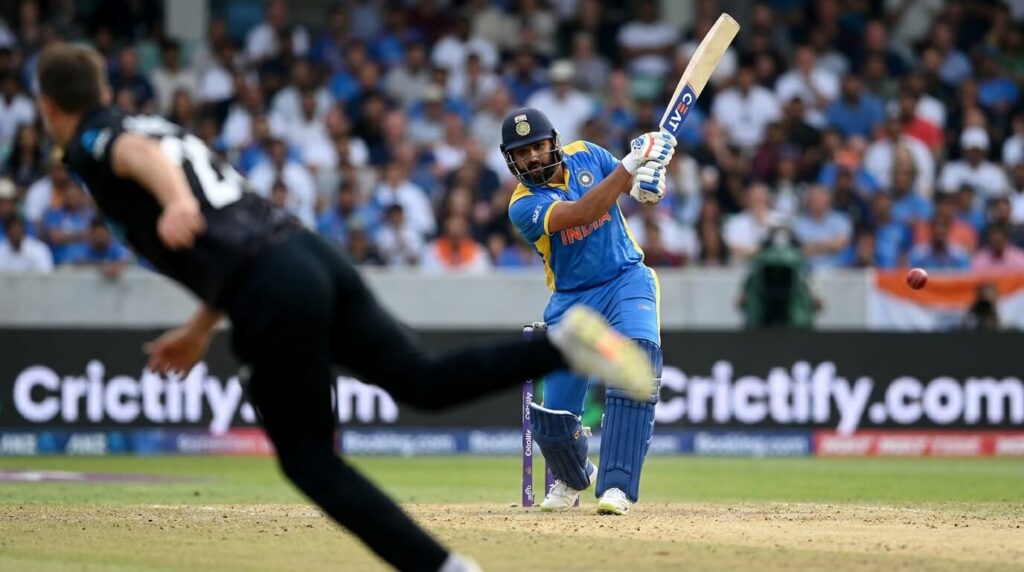
Return to Sport Rates
Overall RTP rates:
- All athletes: 67-85% return to sport
- Overhead athletes: 74-84% return to sport
- Return to pre-injury level: 53-82%
- Time to return: 6-9 months average
Cricket-specific considerations:
- Fast bowlers: May take longer (9-12 months) due to extreme demands
- Spin bowlers: Often return faster (6-8 months)
- Batters/fielders: Variable (6-9 months)
- Wicketkeepers: Similar to fielders, throwing-specific rehab critical
Performance Expectations
Realistic outcomes:
- Most players return to previous level
- Some players experience reduced velocity/endurance
- Technique modifications may be necessary
- Ongoing maintenance required (strength, mobility work)
- Re-injury risk exists (5-15% depending on study)
Factors affecting outcome:
- Age (younger = better)
- Tear type (isolated SLAP = better than combined)
- Surgical technique (repair vs tenodesis)
- Rehabilitation quality and compliance
- Pre-injury performance level
- Psychological factors (confidence, fear)
Long-Term Prevention Strategies
Ongoing maintenance program:
1. Continue strength training:
- Rotator cuff exercises 2-3x/week
- Scapular stabilization 2-3x/week
- Core and lower body 2-3x/week
2. Maintain mobility:
- Posterior capsule stretching daily
- Thoracic spine mobility work
- Hip mobility (especially IR/ER)
3. Load management:
- Monitor bowling overs in training/matches
- Avoid consecutive high-load days
- Periodize training (off-season, pre-season, in-season)
- Listen to early warning signs (pain, fatigue)
4. Technique optimization:
- Regular bowling action analysis
- Throwing mechanics assessment
- Address biomechanical inefficiencies
- Work with qualified coaches
5. Pre-habilitation:
- Pre-season shoulder screening
- Address GIRD early
- Strengthen before problems arise
- Maintain fitness during off-season
Prevention: Reducing Labrum Tear Risk in Cricket
Pre-Season Screening
Essential assessments:
- Shoulder ROM (IR, ER, compare sides)
- GIRD assessment (>20° difference = concern)
- Rotator cuff strength (handheld dynamometry)
- Scapular control (observation, winging)
- Throwing/bowling mechanics (video analysis)
- Previous injury history
- Training load (overs, throws per week)
In-Season Monitoring
Weekly check-ins:
- Pain levels (0-10 scale)
- Shoulder fatigue
- Throwing/bowling volume
- Sleep quality
- Performance metrics (speed, accuracy)
Red flags requiring attention:
- Deep shoulder pain persisting >48 hours
- Clicking/catching that’s new or worsening
- Loss of throwing distance/accuracy
- Reduced bowling speed
- Shoulder fatigue earlier than usual
Load Management
Evidence-based guidelines:
- Fast bowlers: Monitor overs per match, per week, per month
- Throwing volume: Track throws per training session
- Rest days: Minimum 1-2 days between high-load sessions
- Periodization: Off-season, pre-season, in-season, taper
- Multi-format cricket: Manage cumulative load across formats
Technique Coaching
Key biomechanical principles:
- Efficient energy transfer (legs → core → shoulder → arm)
- Proper scapular positioning during cocking phase
- Avoid excessive external rotation beyond capacity
- Smooth follow-through (deceleration control)
- Hip-shoulder separation (generates power, reduces shoulder load)
Strength and Conditioning
Year-round program:
Off-season:
- Build rotator cuff strength
- Improve scapular control
- Address mobility deficits
- Correct muscle imbalances
Pre-season:
- Sport-specific strengthening
- Throwing/bowling progression
- Endurance building
- Technique refinement
In-season:
- Maintenance strengthening (2x/week)
- Mobility work (daily)
- Recovery protocols (ice, massage, sleep)
- Load monitoring
When to See a Doctor
Seek medical evaluation if you experience:
- Deep shoulder pain lasting >2 weeks
- Pain interfering with bowling/throwing
- Clicking, catching, or locking sensations
- Shoulder instability or apprehension
- Loss of throwing distance or accuracy
- Reduced bowling speed without other explanation
- Night pain disrupting sleep
- Pain after diving catch or fall
Urgent evaluation needed for:
- Acute shoulder dislocation
- Inability to move shoulder after injury
- Severe pain with any movement
- Visible deformity after trauma
Internal Linking Opportunities
Primary Internal Links (Existing Crictify Articles)
- Rotator Cuff Injury in Cricket — Comprehensive guide to rotator cuff tears, tendinopathy, and rehabilitation for cricketers
- Shoulder Impingement Syndrome in Cricket — Detailed explanation of subacromial impingement, causes, and treatment
- Shoulder Dislocation in Cricket — Complete guide to anterior and posterior dislocations, Bankart lesions, and stabilization surgery
Disclaimer: This article provides educational information only and does not replace professional medical advice. If you suspect a labrum tear or SLAP lesion, consult a sports orthopedic surgeon or qualified healthcare provider for proper diagnosis and treatment. Individual cases vary, and treatment decisions should be made in consultation with your medical team.